
Wahconah Park’s grandstands are coming down, but winter skating is on the way
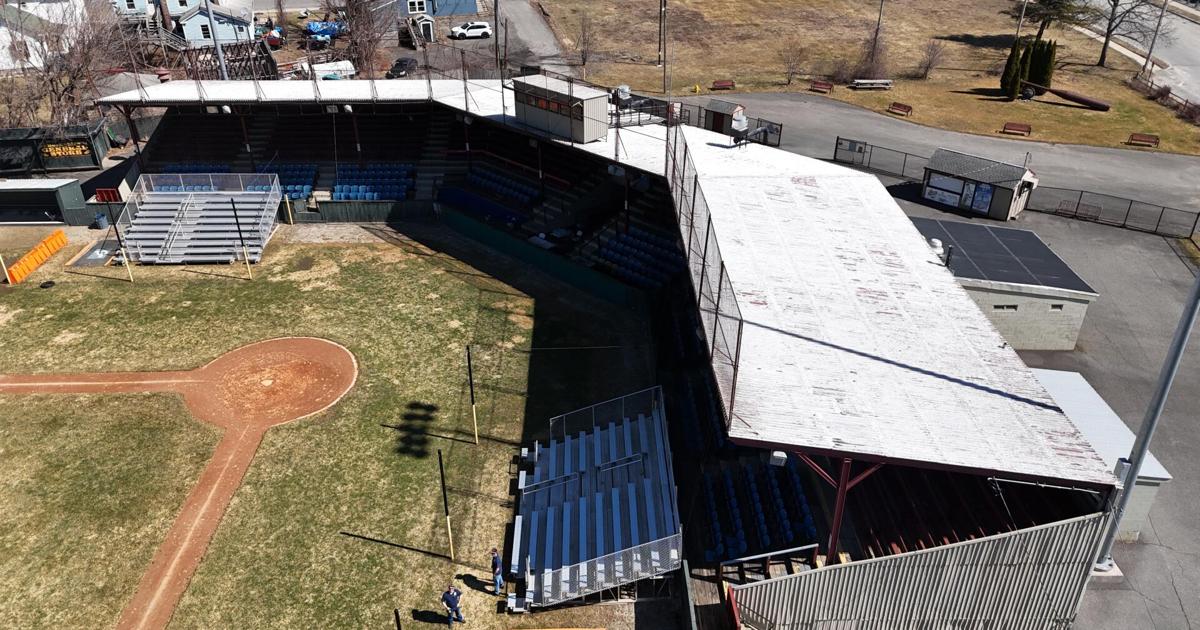
PITTSFIELD — The grandstands at Wahconah Park are finally coming down, and a seasonal ice rink will also make its debut at the ballpark this winter.
On Thursday, the Conservation Commission unanimously approved the demolition of the ballpark’s aging grandstands, which were deemed structurally unsafe in 2022, as well as the installation of a temporary ice rink on the site.
The teardown is the first phase of a broader effort to restore the historic 1919 ballpark, home of the Pittsfield Suns. Temporary bleachers were used during the 2022 and 2023 seasons, but the Futures League team sat out 2024 and 2025 because of the park’s condition.
The demolition, estimated at about $875,000 including hazardous materials removal, will be paid for with existing city and federal funds, said Jim McGrath, the city’s park, open space and natural resource program manager.
Work is expected to begin in early spring, and benches and other landscape features will be removed and stacked for reuse.
The next phase, said Jim Scalise, a civil engineer with SK Design Group, is to begin rehabilitating the park and constructing a new grandstand, which the city hopes to start as soon as demolition is complete. If there is a delay before rebuilding begins, Scalise said the area beneath the former grandstands will be temporarily stabilized with crushed stone.
Last year, the Wahconah Park Restoration Committee recommended a $28.4 million plan to turn the stadium into a multipurpose sports and events venue.
With only about $18 million currently committed — $15 million in city capital borrowing pledged by Mayor Peter Marchetti and $3 million in federal funding secured by U.S. Rep. Richard Neal — S3 Design and the owner’s project manager, Skanska, have signaled that a smaller, more compact design is expected.
Because the project is located in a floodplain, the demolition also affects flood storage. Removing the existing structure will create extra space for water during flooding, and Scalise said he is documenting that “credit” — as well as correcting the elevation benchmark and revising the wetland boundary — so the city can use it when rebuilding new structures at the park.
“What’s happening at Wahconah Park is that we are lessening the amount of improvements that can happen there over time, because every time I do a permit, I end up with less [space],” he said, explaining that previous permits have gradually eaten into available flood storage.
By quantifying the storage created through demolition and tying it to this approval, Scalise said, the city will have more flexibility to rebuild “in a better way” while still meeting floodplain rules.
The demolition will also free up storage space for the 50-by-100-foot temporary ice rink that will sit on the front area of the park along the road.
The rink consists of a tarp with refrigerated lines, bordered by four-foot-tall kickboards, Director of Community Development Justine Dodds said. There will also be three 10-ton chiller units on the north side of the rink enclosed in chain fencing, as well as an electrical panel board nearby.
The ice rink was first slated to operate at Clapp Park, largely because it is close to the Department of Public Works yard and already has parking, water hookups and a small building that could serve as a warming house and skate rental area.
However, when the city put the project out to bid, the cost came in $75,000 higher than the $250,000 the city had budgeted and fundraised for — $200,000 for the rink system and $50,000 in city in-kind contributions for electrical work, maintenance and utilities.
Wahconah Park proved to be the more affordable option, with lower power installation costs and floodlights already in place, prompting the city to shift the rink to its long-term planned location at the park sooner than expected.
The city will purchase the rink for winter use and then roll it up and store it off-site in early spring, Dodds said. About 126 cubic yards of sand will be brought in to level the site. As a condition of approval, all sand must be removed by April 30 and the area must be reseeded and restored to its previous condition.
The Conservation Commission also required that the conservation agent be notified when construction begins, make regular site visits during the work and approve the final restoration. Any changes to the plan must be cleared with the commission or the agent.
Read the Original Article
This article was originally published by Berkshire Eagle. Click below to read the full article on their website.
Visit Berkshire Eagle