
Want to buy Washington's historic Stone House? It's on the market for $350,000
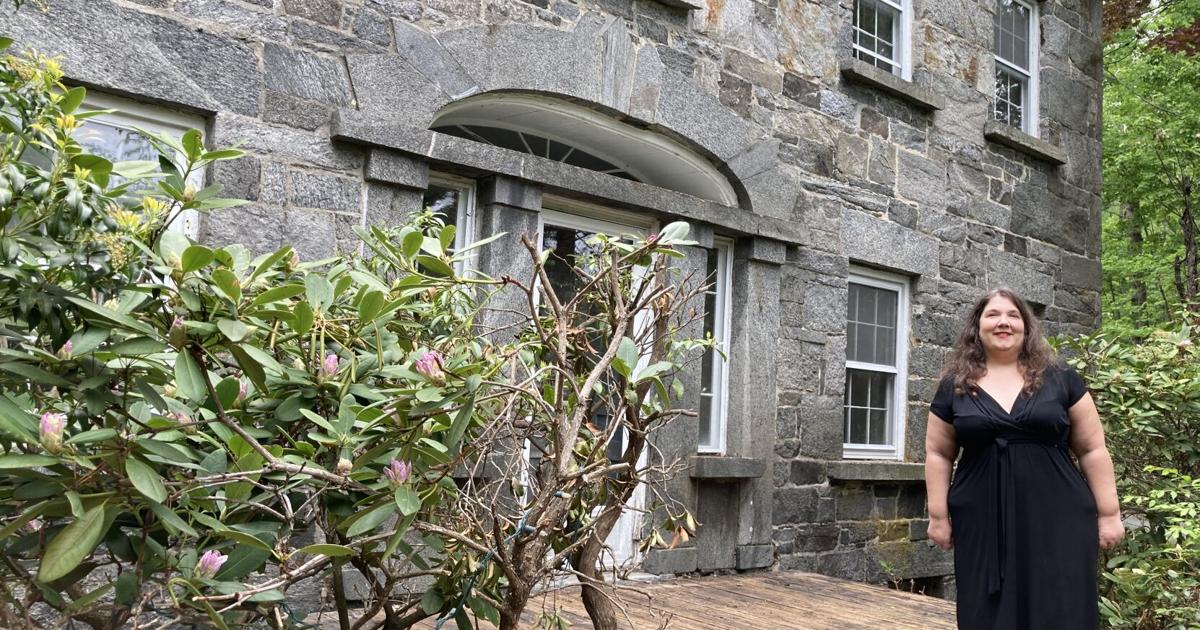
WASHINGTON — Partially hidden by arborvitae, old apple trees, rhododendrons and Japanese maples, this town’s most eminent home is drawing considerable attention.
The Stone House at 88 Stonehouse Road is for sale at a price that has already drawn five potential buyers in its first six days on the market. Three more showings were scheduled as of Thursday.
Its price of $350,000 and the approximately 96 acres that come with it might be driving interest — along with its history and unique architecture.
Heather Greene has had several showings for the Stone House in Washington in the first week it has been on the market.
The house is on the National Register of Historic Places.
Built in 1843 of quarried irregularly cut granite, the house is a relic of the railroad era. In fact, the granite used to construct the house was said to have been blasted from Summit Rock, where the railroad ran through town.
“With its five-bay, central entrance double-pile plan the house is similar to others in Washington,” Betsy Friedberg, a preservation planner for the Massachusetts Historical Commission wrote in June 1986. “It is distinguished by its execution in stone, its fine detailing, and its unusually intact state of preservation.
The front door at the Stone House in Washington has a sunrise.
“The entryway is embellished with an elliptical fan and full-length sidelights, set within a keyed arch and four tapered pilasters of smooth-cut granite,” she wrote. “An enclosed pediment at each gable end is also composed of granite blocks. 6/6 sash windows are accented with granite lintels and sills.”
Since they’re made of stone, all of these features are still intact.
However, a greenhouse added by an early 20th century resident, who was an avid gardener, is not. It collapsed, and the pile of rubble is still is on site. A barn, which was used as a kitchen, is still standing but has yellow tape across the entrance.
The barn behind the Stone House in Washington has yellow tape across the entrance. It was used as the outdoor kitchen.
Upon entering the main house, those who wish to tour are asked to sign a waiver releasing the seller and its agents from injuries.
In March, the deed was transferred from Robert E. Deubel to Wilmington Savings Fund Society.
Heather Greene, a real estate agent at Elite Realty, offered The Eagle a tour of the building, which has old wallpaper, Mexican tile fireplaces and timber frame construction in the attic.
The house doesn’t have a kitchen. The barn, apparently, had an outdoor kitchen.
The fireplaces at the Stone House are each different. One contains Mexican tile.
The outsized Holland Furnace Co. boiler in the basement apparently took coal. The only bathroom in the four-bedroom house is at the top of the stairs on the second floor. It has a sign warning potential users that it is under winterization. The bathtub tucks into a corner of the room.
Greene pointed out features in the house, including old wallpaper, wainscoting and wide plank floors, along with the lone closet on the second floor and built-in cupboards in each of the four bedrooms.
Real estate agent Heather Greene said she hopes someone with restoration experience buys the Stone House in Washington.
Real estate broker Mike Del Greco is the listing agent at Elite Realty. He said it was tricky to figure out a price, given the condition of the property as well as its historical and architectural significance.
He found one comparable property, a farmstead in a neighboring town listed at $400,000. He estimates it will take $1 million to restore it
Capt. Philip Eames, the man who built the house, owned several sawmills in Washington, which, according to Friedberg, “thrived during the town's brief period of prosperity in the wake of the railroad’s construction.”
Who will buy this property?
Greene said she hopes someone with restoration experience takes it on.
“People are curious in the town about the house, what it’s like inside and what’s going on with it,” she said. “I definitely think there’s a lot of interest in least in what’s happening to the house.”
Read the Original Article
This article was originally published by Berkshire Eagle. Click below to read the full article on their website.
Visit Berkshire Eagle