
Want to know if you if you need lifestyle changes to slow down Alzheimer’s? A group of Williamstown seniors may be using their phones for clues
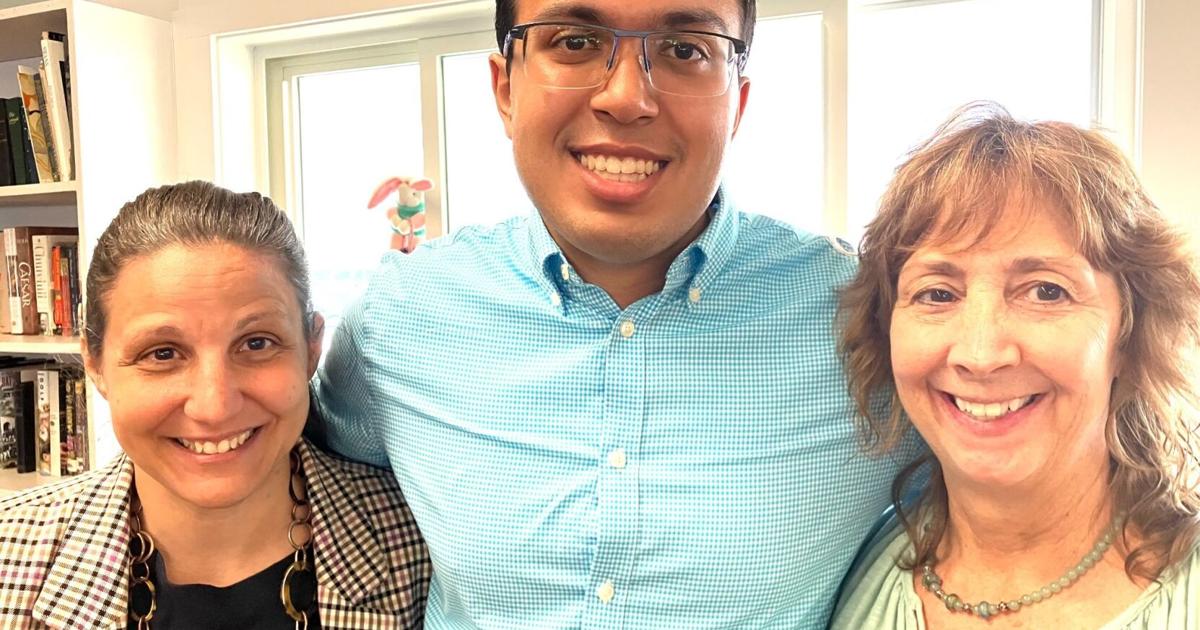
WILLIAMSTOWN — Pete Spencer and Diane Parsons may soon find out — via hints from their mobile phones — if they’re likely to develop Alzheimer’s or related diseases. And if so, they may have time to do something about it to extend their quality of life.
The two retirees were among 23 people — 19 women and three men — who gathered April 10 at this town’s Harper Center for Senior Citizens for a luncheon of pasta, egg or tuna sandwiches — and a pitch from two Dartmouth Medical School researchers.
The pitch: Join 200 patients nationwide to test a digital phone application. In about two hours and four tests, the researchers say the application may reveal faint but distinctive signals of looming dementia.
Researchers have determined four predictive behavioral signals of potential developing dementia involve features of walking, speaking, eye tracking and the intensity of smiling — all things a mobile phone can measure with its camera, touch screen, motion and balance detectors.
The researchers hope the signals will prompt medical intervention as long as 10 years before memory, movement, talking and thinking are noticeably impaired — rather than the more typical two years warning now common. They hope the phone may spotlight problems earlier than spouses or family do, prompting in-office clinical testing. Their first report of findings is due for release June 30.
Early warnings of dementia can give patients an incentive to begin lifestyle modifications involving diet, physical activity and brain exercises that are believed — for some people — to slow dementia development significantly.
“You hear all the time to go exercise, go on a walk,” says Karen L. Fortuna, Ph.D., a former social worker turned community and family professor at Dartmouth College’s Geisel School of Medicine. “Maybe this dementia screening might push you to go do those things to stave off progression of disease. It’s kind of a race to figure out.” Fortuna is the research leader.
The current state of the science is that people have to physically go into primary-care or other clinical locations, where doctors can detect these early signs up to two years early, Fortuna explains. That’s a barrier. Fortuna’s goal is to make it easier for the public to test for the same behavioral signals — but from home — using their mobile phones.
An article in Dartmouth’s alumni magazine described the app, called RealVision, which “tracks how users interact with their phones, noting such changes as disoriented eye movement, difficulty with typing, or needing more time to respond to prompts.”
“The long-term goal is to partner with spouses, daughters, sons, and caregivers — the people most likely to observe a loved one’s changing behavior,” Fortuna told the magazine. “And tap into the power of these relationships to encourage someone to download the app and potentially identify pre-clinical Alzheimer’s early on.”
At the Harper Center, Fortuna’s research colleague Vedan Taplivana, a Dartmouth senior undergraduate, was busy explaining to the 23 seniors that the testing starts with research consent and privacy agreement, followed by a 30-minute medical-history survey completed either on paper or via an online Dartmouth website. Then participants will download the RealVision app and spend another 30 minutes at home going through testing of their walking, speaking, eye tracking and smiling.
The phones process the data — but send results only to Dartmouth, preserving user privacy. “Any video taken of you is processed on your own phone,” said Taplivana. If the results suggest early-stage dementia symptoms, Taplivana says, there is a way to contact the participant and suggest they get a clinical screening to confirm what the phone testing shows.
Taplivana spends 30 minutes explaining all this and answering questions. Then he circulates among the volunteers, collecting their signed research consent forms. By driving two hours from Dartmouth to Williamstown, researchers know they are dealing with real people, not computer “bots.” Otherwise participants have to prove their real-person identity through an online video confirmation and documentation process.
Most of the 23 participants left planning to fill out the survey and do the phone app behavioral testing later. But Spencer and Parsons decided to go ahead right away. After the 30-minute presentation, they were working at lunch tables filling out the initial medical history document in writing and handing it personally to Fortuna, thus confirming a real person filled it out.
Why do they want to take the test? Living fullest and curiosity, Spencer and Parsons say.
“I thought it was worthwhile,” said Spencer, 82, a retired electrician who recovered astronauts from their space capsules as a Navy SEAL. He was asked to participate. The written survey was tedious, and, “I wouldn’t want to do it again,” he said. Spencer borrowed Taplivana’s cellphone to complete the app portion. He followed a red ball with his eyes, smiled for the camera and walked for two minutes among other short tests. “The measuring smile seemed to be important,” he said, adding: “I always have had trouble making a big smile so I was trying to think of something funny so I could chuckle.” He said being part of the Dartmouth testing reminded him that “it shouldn’t take something like this to live every day to its fullest.”
“I’m 86 so maybe I’m too old for the study,” said Parsons. “But I’m curious to know and I don’t want to lose my curiosity and interest.” A former North Adams city councilor, Parsons worked in education and teaching before retiring. She now lives in Adams. “I forget names and I lose my words and I want to see if I have any of the hallmarks and other signals.” She already completed the 30-minute written questionnaire and is waiting to receive the software for her phone. She said the survey asked multiple questions about sleep patterns.
Parsons, for her part, has an extra special reason to participate. Her daughter, Sarah J.P. Kline, is the Harper Center’s outreach coordinator. When the Dartmouth team sent out over 200 requests nationwide for participation in their study, Sarah was the first to respond, and the relatively short two-hour drive from Dartmouth made it easy. The Harper Center may be the only in-person cohort for the app test, Fortuna says.
“Sarah was great,” laughed Fortuna, as Kline busied herself serving lunch to the seniors. “Go Sarah!”
In a post-visit email in response to questions, Fortuna elaborated on aspects of RealVision.
“Many of these signals, like subtle changes in gait or facial expression, have been studied for years in research settings, but only recently have we had tools sensitive enough to detect small changes early and consistently,” Fortuna wrote. “Even then, they are not diagnostic on their own; rather, they are early signals that something may warrant closer attention.”
She says features of walking gait can be associated with early brain change — stride length, variability, balance and subtle changes in walking rhythm. Similarly facial changes such as those in muscle movement, symmetry, responsiveness, or emotional expression can signal subtle brain change.
“Some of these patterns are quite nuanced and may not be easily noticeable to the human eye in real time, especially when they are very subtle,” she adds. “That’s where computational approaches can help by detecting patterns across many small signals over time.”
Computers at Dartmouth look for patterns in study participants’ results with a goal of supporting early awareness and conversation, not to replace in-person clinical evaluation.
“This is still an evolving area of science,” Fortuna says. “These tools are meant to complement — not replace — clinical judgment, and we are very mindful of not over-interpreting signals or causing unnecessary concern.”
Read the Original Article
This article was originally published by Berkshire Eagle. Click below to read the full article on their website.
Visit Berkshire Eagle