
Who will administer and score end-of-course exams if they replace MCAS as high school graduation requirements?
PITTSFIELD — Questions about how to design, administer and pay for new graduation requirements — including end-of-course exams — linger as state officials continue refining a proposal that could reshape how Massachusetts students graduate from high school.
The proposed requirements, which also prescribe minimum curriculum requirements, were the topic of a panel discussion at Berkshire Educational Resources K-12’s annual convening, held on March 20 at Berkshire Community College.
Gov. Maura Healey appointed a statewide K-12 Graduation Council in January 2025, just two months after voters approved removing a minimum MCAS exam score as a high school graduation requirement. In December, she unveiled the council's initial proposal, including end-of-course exams which she emphasized would not be “high stakes” graduation requirements.
The MCAS ballot question, which passed with 57 percent of the vote, required students to only "complete coursework certified by the student’s district" to graduate. The test is still being given to students in grades three through eight and grade 10 (high school sophomores) as an assessment tool driving the state’s school accountability ratings.
The proposed requirements also include passing the MassCore curriculum, which is already in place at several area districts; completion of a senior-year capstone project or portfolio; filling out the state or federal college financial aid form; and completing a financial literacy class.
But who will review, grade and pay for thousands of subject-specific tests? That was top of mind for North Adams Superintendent Tim Callahan and Mount Greylock Regional School Committee member Carrie Green during the panel discussion, in addition to who will implement the other requirements.
Callahan said he can support end-of-year assessments if they’re designed and provided by the districts themselves, with state Department of Elementary and Secondary Education guidance.
“There are other ways that the state could monitor those expectations without having it be a state designed, state-scored assessment, which would just add an overwhelming burden to schools to coordinate and would really narrow the curriculum in a way that Massachusetts does not believe in,” Callahan said.
The panel also included two members of the K-12 Statewide Graduation Council: Jenny Curtin, the director of education for the Barr Foundation, and BCC President Ellen Kennedy.
Kennedy said she understands Callahan’s concerns, but added: "There is a need to know that students have had an education that prepared them for what comes next. And I'm not sure how you get that if it's internally assessed by the people who have provided in the first place."
Curtin said the council is trying to forge a balance between common tests and locally designed assessments such as portfolios that capture students’ overall knowledge and skills.
But Curtin also warned against letting districts completely determine graduation requirements. “Grade inflation is a really big deal, and so we can't rely on grades and local accountability alone,” she said.
Greene, however, asserted that local teachers are the best way to assess student achievement.
“We have frameworks. We have talented teachers. We have incredibly talented students. Let them do their work together and trust that how we are assessing students through our education system is providing the information that we need in order to assess whether our students can do college or do jobs right,” Greene said.
Greene also questioned how districts already struggling with insufficient funding will afford to implement capstone projects and portfolios as graduation requirements — or whether they will become yet another unfunded mandate.
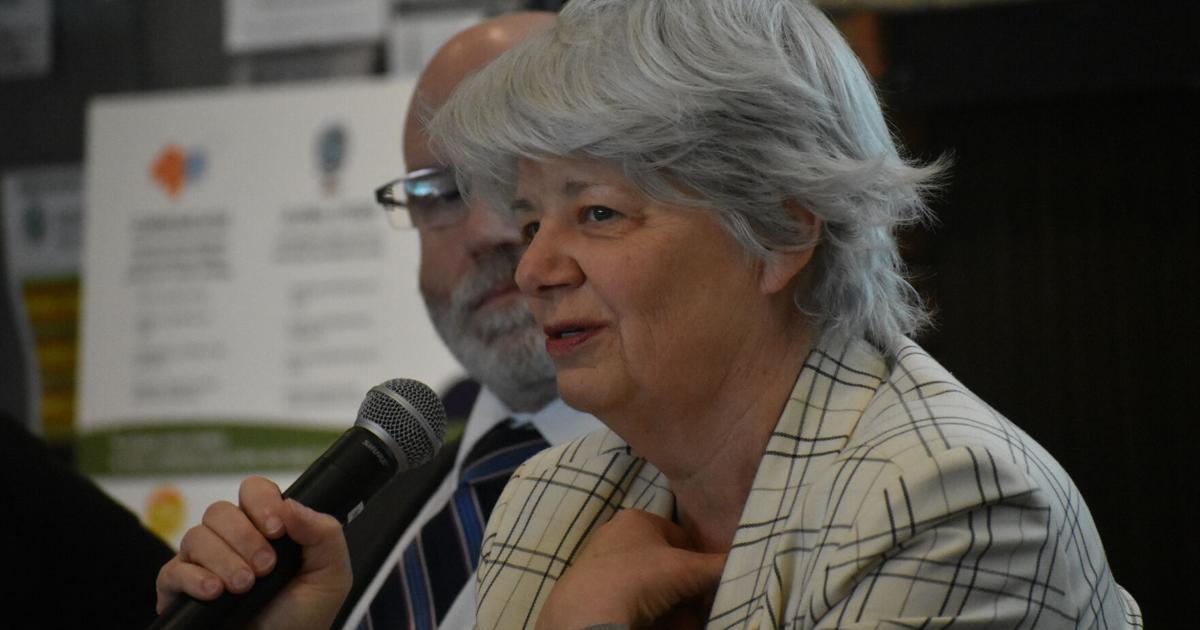
Pittsfield High School senior Koby Cross, right, was among participants at a panel discussing the future of high school graduation requirements at an event held by Berkshire Educational Resources K-12 at Berkshire Community College on March 20. Looking on is Mount Greylock Regional School Committee member Carrie Greene.
Panelist Koby Cross, a senior at Pittsfield High School who plans to attend college next fall, was asked how he and his peers feel about the MCAS tests. Mostly, they’re like any part of school, he said. “I don’t look forward to it ... it comes and goes.”
“How I know [what I’ve learned] is from grades,” he said.
Greene and Callahan were largely in favor of applying the MassCore standards used by the state university system in admissions. But they balked at requiring two years of a world language, explaining that finding and hiring world language teachers has become practically impossible.
When Callahan was an administrator at Drury High School, “we went six years with an open foreign language position and zero applicants. So how can you establish that foreign language must be a graduation requirement when in small rural areas we get zero applicants for those positions?” he asked.
Callahan also asked that the federal student financial aid form requirement has an opt-out provision, noting that many families simply do not trust government agencies with financial information. Aside from that, he sees value in making students aware that college need not be unaffordable.
“It’s not the student not completing the FAFSA, it's the family being unwilling to fill out the documentation,” he said. “But I do believe having it as an expectation at least opens the doors for the conversation and demystifies college funding and resources.”
As for the end-of-course exams: If they're not "high stakes," as Healey has insisted, do they count? And if exams don't count, what's the point?
Kennedy said the council continues to grapple with how to make those exams matter to students without recreating the make-or-break MCAS drama voters rejected. Rather, she sees them as one part of an overall assessment.
“'Not high stakes' doesn’t mean 'doesn’t count,'" Kennedy said. "The end-of-course assessments being discussed are designed as one weighted component of a larger mosaic — the conversations I participated in explored something in the range of 10 percent of the overall graduation determination."
"It has to be a framework where assessments count appropriately, as part of a whole picture, rather than as a single high-wire act."
Read the Original Article
This article was originally published by Berkshire Eagle. Click below to read the full article on their website.
Visit Berkshire Eagle