
Why are more students turning to vocational education in Berkshire County?
During a visit to Charles McCann Technical High School in North Adams, Darin Almeida asked students to imagine a chilling scenario.
“It's Saturday morning, Jan. 3. It's 6 degrees out. You wake up in your house and your heat isn't working,” he said. “It's 48 degrees.”
Almeida asked students what they would do. He offered they would likely search for an HVAC contractor like Laureyns United, where he is vice president.
But finding a technician isn’t as easy as calling them, Almeida said.
“As much as it pains us to tell you this, we're not going to take you on because you're not an existing customer, because we're already overburdened,” said Almeida, noting that the problem is not unique to his company. “Nobody's coming to your house … that's where we are right now in our state and in Berkshire County.”
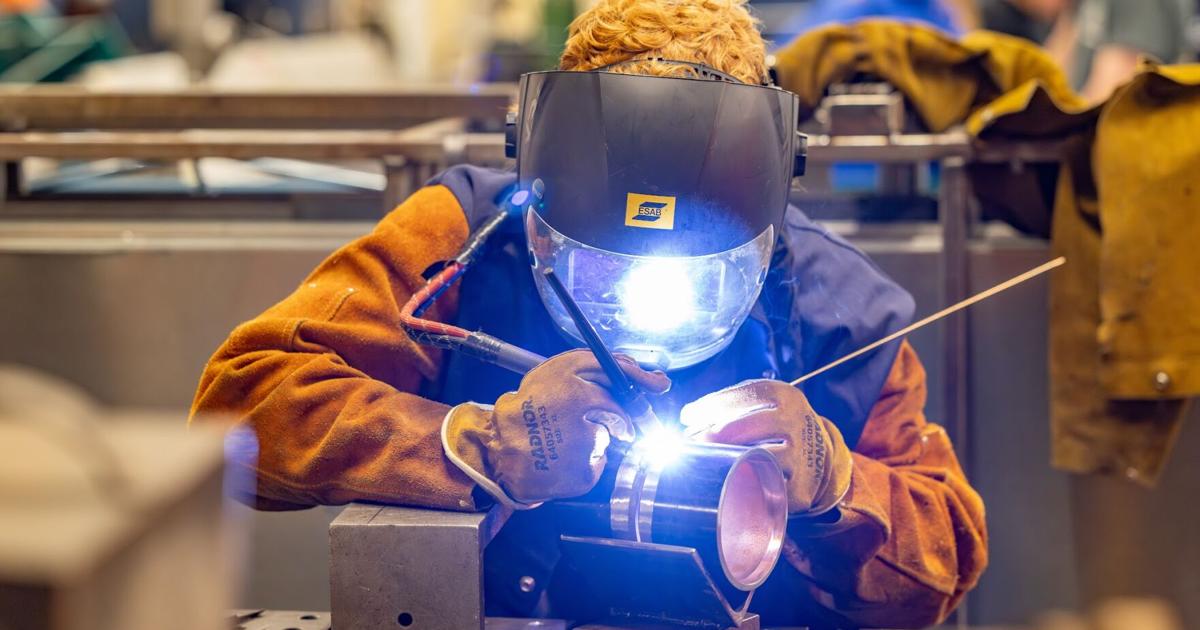
Hayden Poirot, 15, works in the Advanced Manufacturing Technology shop at McCann Technical High School in North Adams.
To meet demand, the major vocational high schools in the county, McCann Technical and Taconic High School, have significantly expanded programs to prepare more students to enter skilled trades.
The number of high school students in Massachusetts remains stagnant, but interest in vocational education has surged. A study by the Boston-based Pioneer Institute found vocational and technical education enrollment increased by 24 percent since 2011. Waitlists can be long, especially in populated areas.
The nonprofit’s study found vocational students accounted for about one-fifth of the state’s public high school enrollment.
Massachusetts vocational schools operate under state law Chapter 74, which requires students to meet academic standards while they complete at least 900 hours in a state-approved trade such as carpentry, metal fabrication or cosmetology.
Taconic High School carpentry students assemble roof trusses for a house under construction for Habitat for Humanity, gaining hands-on experience while helping build an affordable home for a local family.
In Pittsfield, Taconic transitioned to a full vocational school in 2018, opening its new building with eight programs. Since, the school has added a program, or shop, every year, with community input and approval of an advisory board. They offer 15 shops and have applied for a state grant to create a plumbing program.
Administrators at McCann and Taconic said vocational school provides students with the most options after graduation.
A graduate of Taconic’s horticulture program, Principal Matt Bishop said, can enter the workforce immediately with industry credentials, pursue additional training or college with an advantage, or choose an entirely different path.
McCann and Taconic vocational programs are full but don’t have long waitlists.
McCann offers nine programs, including computer-assisted drafting, automotive technology, electricity, culinary arts and multiple growing postsecondary training programs for adults. In 2024, McCann opened the county’s first HVAC and refrigeration program to freshmen; this spring, the now-juniors will be eligible for a co-op.
Almeida served on an advisory board that determined the need for the program, and the state awarded McCann a $3.1 million Skills Capital grant that allowed the school to build the new HVAC/R building and purchase equipment.
Executives and companies, like Almedia at Laureyns, are asking when co-op students will be ready for work.
“I've had April 2026 marked on my calendar for almost three years now, waiting for these students,” said Almeida.
Laureyns employs about 15 technicians, and Almeida said he could easily hire 10 more for the work available. “And I'm not alone.”
Inside the advanced manufacturing technology classroom recently, freshmen designed parts for their first project — an aluminum bottle launcher they will have to successfully launch on school grounds with the help of 27-year AMT instructor, Scott Botto.
The assignment requires students to learn how to use lathe and mill machines. For one small trigger mechanism, they spent an entire class writing the program, programming the machine and cutting out the part.
“Sophomores could have this done in under an hour,” said Botto, noting the kind of progress he sees each year.
Schools need to update technology and machines to keep up with industry standards, so students learn more advanced technology at a younger grade each year. “What used to be taught to seniors, we are teaching to freshmen,” Botto said.
Sophomores Alivia Ostrowski and Hayden Poirot chose McCann for different reasons.
Poirot dreams of making prosthetics. He chose McCann because he thinks it will set him up to be ahead of the curve for biomedical studies.
“I’ve already planned ahead to go into some sort of engineering, and I’ve always wanted to make something helpful for people,” said Poirot.
Ostrowski’s dad and aunt attended the school. She was intrigued by the idea of having a certified skill when she graduates, though as of now, she plans to go to college for something other than her trade.
“I will always have something to fall back on,” she said.
Both students said the hardest part has been building confidence to operate expensive machinery.
Justin Kratz, principal of McCann Technical High School in North Adams, says vocational education gives students multiple options after graduation, from entering the workforce with industry credentials to pursuing college or advanced training.
“These are things you're going to actually use,” said Justin Kratz, principal of McCann Technical High School in North Adams. “So, I love the fact that we throw 15-year-olds on $250,000 pieces of equipment.”
Almeida said when he attended Pittsfield High School, vocational students were called “voc-ies.”
Administrators say that perception is changing.
“College is a good option,” said Kratz. “It is a legitimate option. But it’s not the only option.”
Last year, the state’s Department of Higher Education released earnings data of public postsecondary programs that say postsecondary degrees are associated with $20,000 to $30,000 higher compared to a high school diploma. But the field of study mattered.
Hayden Poirot, 15, works in the Advanced Manufacturing Technology shop at McCann Technical High School in North Adams.
Five years out of school, health, STEM and trades fields are associated with the highest earnings. In some cases, students with associate degrees in high demand fields like health and trades out-earn those with bachelor’s degrees in lower-paying fields such as humanities and education.
The median earnings of someone with a bachelor’s degree five years out of school were higher in trades professions than humanities, education, and social and behavioral sciences.
Kratz and Bishop said about half of students go on to college, although they are encouraged to start thinking about potential career paths long before senior year.
In a recent poll of 600 Massachusetts residents, conducted by Boston-based market research and polling company, Opinion Diagnostics, 95.6 percent said they supported expanding access, or adding more seats, to vocational-technical schools.
Officials and local tradespeople said the stigma of the schools still exists, which can prevent students from knowing vocational education is an option.
A Taconic High School television production student practices on the set in the school’s media studio, where students learn broadcasting, editing and on-air presentation skills as part of the career technical education program.
Running a vocational school is expensive. Equipment must match industry standards and requires constant maintenance, culinary programs face rising food costs, and new programs often depend on competitive state grants. Instructors must maintain professional credentials outside the school day — a requirement traditional academic teachers don’t face.
At Taconic, Bishop said “culinary folks put on a restaurant for real guests, cosmetology has real clients, and our automotive program works on real customer cars.”
“If I break my leg, my orthopedic surgeon is my No. 1 person,” Brosnan said. “If the lights go out, it becomes my electrician. If the toilet doesn’t work, it’s my plumber. If my car doesn’t work, there’s nobody on earth today that can fix cars other than trained technicians.”
Read the Original Article
This article was originally published by Berkshire Eagle. Click below to read the full article on their website.
Visit Berkshire Eagle