
Why did BSO trustees break up with the orchestra’s revered maestro? CEO Chad Smith reveals some clues
LENOX — Despite appeals from Boston Symphony musicians, 3,200 audience members who signed a petition and international stars like Lang Lang, BSO leadership says there will be no reversal of its decision to part ways with Music Director Andris Nelsons at the end of the 2027 season at Tanglewood.
Two months after that bombshell announcement — one that stunned the classical music world — BSO President and CEO Chad Smith told The Berkshire Eagle this week that the orchestra's decision to end Nelsons' "evergreen" contract is final.
"The answer is no," Smith said. "The board made a very considered decision, a final decision not to renew his contract after 2027. I've heard nothing to the contrary from the board that would indicate a change in opinion there."
Chad Smith, who began his tenure as president/CEO of the Boston Symphony Orchestra in September 2023, offered high praise for Music Director Andris Nelsons' conducting during Eagle interviews in 2024 and 2025. Now, he's stating the trustees' breakup with Nelsons as of August 2027 is caused by the conductor's opposition to at least some of the new strategic plan.
According to Smith, the impending breakup with Nelsons resulted from "his lack of support for the BSO's future vision" as outlined in management's new strategic plan.
The strategic plan is essentially a roadmap for its future — focusing on fixing and preserving facilities at Symphony Hall and Tanglewood, rethinking its concerts and artistic offerings, and expanding its educational and community outreach work. The plan is aimed at making sure the organization remains financially and culturally sustainable for the long term.
Smith declined to say if the music director opposed all or parts of the plan, which includes a focus on Tanglewood as a model for the orchestra's future programming and community engagement.
"There are certain things we cannot say," Smith said, "but it's a question for Andris."
There have been reports that non-disclosure agreements are in place.
"It became clear that Andris didn't support the strategic plan," Smith said.
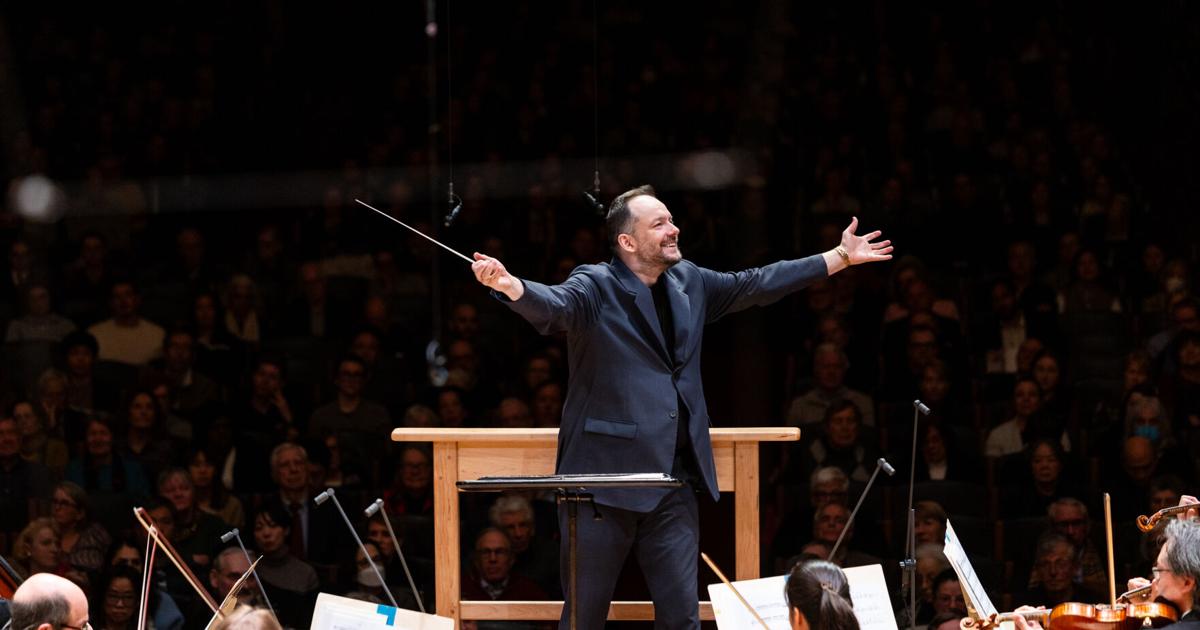
Boston Symphony Orchestra Music Director Andris Nelsons, seen conducting at Tanglewood in July 2024. BSO President and CEO Chad Smith told The Eagle this week that the decision to terminate his contract after the 2027 Tanglewood season is final because Nelsons didn't support some or all of the management's new strategic plan.
Nelsons has declined comment, save for a statement on March 6 that the termination of his role was "difficult news, this was not the decision I anticipated or wanted" and that he understood "the decision was not related to artistic standards, performances or achievements during my tenure."
The decision by the board of trustees, chaired by philanthropist Barbara Hostetter, plunged the orchestra into turmoil. The Players Committee, which represents the musicians, said they were blindsided, played no role in the decision and received no advance warning.
In an editorial last weekend, the Boston Globe opined that "a sensible board would recognize Nelsons isn't the problem and try to patch things up while there's still time. But then a sensible board wouldn't have gotten itself into this mess in the first place."
The musicians, many donors and audiences in Boston and at Tanglewood are deeply loyal to Nelsons, 47, a native of Latvia who has been the BSO's music director since 2014. During his podium appearances last month, audiences at Symphony Hall in Boston demonstrated their support for the maestro.
"This is not the way we would have wanted this to roll out," Smith said. "There are many things we would have done differently. We knew this decision would be difficult and would be taken hard by many in our community. The rollout was challenging, but the board knew this was the right decision and stands by it."
"I'm interested in having a music director who is a true partner across the organization's work going forward," Smith said.
The difficult task ahead is to find a new music director — a search that will include four members of the board, two staff members and five orchestra members in advisory roles.
In Smith's view, the result should be "an extraordinary artistic leader who is a creative partner also deeply engaged with making Tanglewood and the BSO even more deeply meaningful in these communities. It starts with musical excellence on the podium, and it always will."
Andris Nelsons conducts the Boston Symphony Orchestra on Jan. 22 at Symphony Hall in Boston.
The search will take time. The Los Angeles Philharmonic, the San Francisco Symphony and the Cleveland Orchestra are among major competitors on the hunt for new music directors.
The Eagle asked Smith how one could regain the players' trust.
"The board and I had started this process by wanting to engage the musicians directly in the conversation," he said. "That continues to be the way we're going to build trust — through direct, critical conversations — and we're doing that now at the negotiating table. That is our opportunity. It's going to be communication. It has to be."
Bargaining has started for a new contract with the orchestra. The current three-year agreement expires Aug. 23.
Not long ago, Nelsons and the BSO were in it for the long haul.
In Eagle interviews in the summers of 2024 and 2025, Smith expressed the BSO's enthusiasm for Nelsons.
"He's been giving one great concert after another, and I feel like the orchestra has been playing at a level that is just so exciting. He's conducting with such incredible energy and vigor. He's on fire," Smith told The Eagle last August.
In January 2024, when Nelsons' contract was revamped into a "rolling, evergreen" deal with no expiration date, Smith said the agreement to extend his role with the BSO into the foreseeable future expressed the organization's "deep confidence in his artistic leadership."
"I know that Andris will continue to make the BSO healthy and vibrant for years to come," Smith said.
Also, in January 2024, Smith told the Boston Globe that "as long as this keeps going and Andris stays happy with Boston, then we're going to keep this train on the tracks. What it means, fundamentally, is that the next time we talk about his contract is going to be that unfortunate day when Andris decides that he's been here for X amount of time."
Andris Nelsons conducts Beethoven's Leonore Overture at Concert for the City on September.
What changed so dramatically since those statements?
Smith answered: "What I said about Andris' artistry absolutely stands. Those concerts last summer were extraordinary. Even after the board made the decision in February, he and the orchestra gave some extraordinary concerts, including at Carnegie Hall. This is not about the artistry of Andris."
So, what was it about?
"It's more nuanced and a harder story to tell," Smith said, referring to the BSO leadership's new strategic plan "to address some of the systemic issues that perhaps have been ignored for too long."
Smith, who joined the BSO in September 2023 after 20 years in various roles at the Los Angeles Philharmonic including serving as its CEO, listed declining ticket sales and subscriptions, operating deficits, and up to $100 million deferred maintenance divided equally between Tanglewood and Symphony Hall.
"We have to reimagine our programming in ways that center the core repertoire, but also looked at how we expand our audiences and bring more people into our work," he said, "not by dumbing down our repertoire but making it more inclusive, by thinking about different ways of presenting our work, through thematic festivals, artist curation and artist residencies. These are not radical ideas. They would allow us to tell different stories about this extraordinary music."
Boston Symphony Orchestra at Symphony Hall, Thursday, March 19 in Boston. "It became clear that Andris didn't support the strategic plan," Chad Smith said of Music Director Andris Nelsons.
Smith said "the path forward on artistic re-imagination" is based on the framework of the Tanglewood Learning Institute, or TLI, at the Linde Center at Tanglewood. TLI focuses not only on concerts but also on the humanities and lectures by academics, artists and activists.
Smith suggested that Tanglewood is the model for the orchestra's future at Boston's Symphony Hall. As an example, Smith pointed to Yo-Yo Ma's five-day curation residency this August involving performances and programming, titled "We The People: Our Shared Past, Present and Future."
"That's what artist curation at the highest levels of excellence looks like," Smith said.
He also touted "arguably one of the biggest Popular Artists seasons that the BSO has put on" at Tanglewood, with 18 shows by 16 artists and groups.
He declined to confirm reports that, on average, popular artists get 90 percent of the box office take, with the rest going to the BSO.
"We negotiate very fair deals for the popular artists that are great for them and good for the BSO," Smith said.
He depicted the Popular Artist series as supporting "our signature classical programming," while attracting some of the venue's most "age-diverse, racially diverse" audiences and helping to support the educational mission at the Tanglewood Music Center.
"It doesn't diminish what happens with our orchestra," he said.
He cited the 60 events at the Tanglewood Learning Institute held between last September and this month, taking Tanglewood year-round.
Smith called Tanglewood "the single greatest campus for music and learning anywhere in the world" and Symphony Hall "the finest four walls in the world to hear an orchestra play classical repertoire."
Yet "we have been woefully inadequate in investing in those spaces," Smith said.
Smith cited two examples at Tanglewood: The Theatre-Concert Hall, a performance space designed by legendary architect Eliel Saarinen and built in 1941, and the Seranak mansion, where conductor Serge Koussevitzky once lived, overlooking the campus from West Street. Both are now closed and in need of renovation and restoration.
In a recent memo, Hostetter wrote that "critical fundraising initiatives have, unfortunately, been severely set back in recent weeks by the activities of certain BSO personnel and other members of the BSO community, who have, among other things, been spreading false and misleading rumors and innuendoes regarding the strategic planning process, the board of trustees and its leadership, on social media and elsewhere. This regrettable conduct has caused real financial and reputational damage to the institution, which will be hard to repair."
Boston Symphony Board of Trustees Chairwoman Barbara Hostetter, seen on July 4, 2024, presenting James Taylor with the prestigious Tanglewood Medal. She recently wrote that “critical fundraising initiatives have, unfortunately, been severely set back in recent weeks by the activities of certain BSO personnel and other members of the BSO community, who have, among other things, been spreading false and misleading rumors and innuendoes regarding the strategic planning process. This regrettable conduct has caused real financial and reputational damage to the institution, which will be hard to repair.”
Asked to respond, Smith said he didn't think the memo was targeting the players, but that clarification is needed. He said that the 2025 fiscal year yielded the biggest fundraising total in the orchestra's history — close to $70 million, including $30 million in annual fundraising and $40 million in endowments and capital projects.
This year's goal is $30 million in annual fund campaigns and $15 million to $20 million in non-operating donations.
"And we're on track to do it," he said.
While that total is less than the previous year, he said that last year's fundraising peak resulted from donor excitement over the strategic plan. This year, with challenges "and some discrediting and distancing from that strategic plan, we've had to put some conversations about big seven- or eight-figure gifts on pause," Smith said.
"When we are able to rebuild the momentum of the strategic plan, we'll go back to those donors and restart those conversations," he said.
However, he said that "some donors, who are saying they're not happy with the turmoil they're seeing, are pulling back."
On the other hand, Smith said some donors are increasing their giving because they "believe in the leadership and in the direction the BSO is going."
"So, some are pulling back and some are leaning in, and that is the reality of our current situation."
Still, he said, "change is hard, there are a lot of intense feelings and I recognize that, but Boston and the Berkshires deserve a BSO that we're envisioning in the strategic plan."
"Excellence is not just something to cherry-pick. It has to be a value we apply to every decision we make," Smith said. "The BSO faces significant challenges, and we are not alone in the arts and cultural world with these challenges."
"We're going to fix it, so we have to be aligned across all of leadership — board, staff and artistic," he said, echoing his earlier explanations that Nelsons had not been aligned with the BSO's vision for the future.
Read the Original Article
This article was originally published by Berkshire Eagle. Click below to read the full article on their website.
Visit Berkshire Eagle