
Williamstown voters approve all funding requests after debate over school and recreation spending
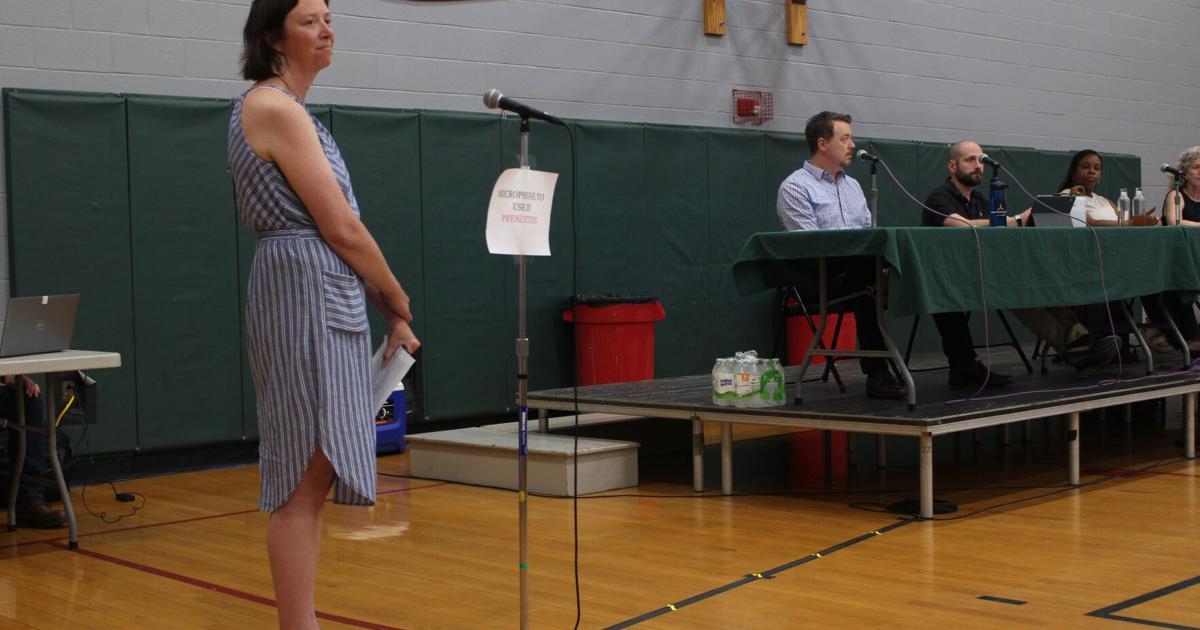
Williamstown annual town meeting voters took the microphone to debate whether the town should fund a math interventionist at Williamstown Elementary School.
WILLIAMSTOWN — Concerns over rising costs and town spending surfaced repeatedly during Tuesday night’s three-hour annual town meeting, but voters ultimately approved every funding request before them.
The 389 residents gathered at Williamstown Elementary School approved 31 of 32 warrant articles, including the town’s proposed $28.6 million fiscal 2027 budget, but debated funding for a new math interventionist at the elementary school, the skate park and upgrades to Sand Springs Pool and Recreation Center.
The biggest part of the budget, a recommended $16.8 million for Mount Greylock Regional School District, passed along with an amendment brought by local parents to the meeting to add the math interventionist, increasing the school budget by 14.5 percent instead of the 13.6 percent the town calculated for a level service budget.
The amendment passed 233-102 against town recommendation after residents debated whether the town should add the $120,000 position despite mounting budget pressures and recent curriculum changes.
Jenna Hasenkampf speaks at Tuesday's annual town meeting to ask the town to fund a math interventionist at Williamstown Elementary School. “The position is not funded in the district budget and we are asking our community to make that final decision," she said.
“This position was our top budget priority,” said Jenna Hasenkampf, a parent representative in the district’s School Council. “The position is not funded in the district budget and we are asking our community to make that final decision.”
School Committee Chair Julia Bowen acknowledged about 40 percent of students are below state standards in math but said the committee had to balance improvement efforts with ballooning operation costs.
Mount Greylock Regional School Committee Chair Julia Bowen speaks about why the town ultimately did not recommend funding a math interventionist at Williamstown Elementary School. “[The recommended budget] represents difficult decisions we discussed and made as a committee,” she said. “That we've had to make with state shortfalls and federal budget changes.”
“[The recommended budget] represents difficult decisions we discussed and made as a committee,” she said. “That we've had to make with state shortfalls and federal budget changes.”
The town also OK'd funding to add one police officer, which the department said was crucial to being properly staffed without relying on overtime.
Without the math interventionist adjustment, the tax bill for a median single family home would be $7,067.91 in fiscal 2027, an increase of almost 10 percent, or just over $600, from 2026, according to the proposed town budget.
Voters approved all of the recommended Community Preservation Act spending — but two requests got people out of their seats and waiting for the microphone.
An article to spend $20,000 of Community Preservation Committee funding to build a new outdoor sauna at Sand Springs Pool and Recreation Center passed 190-48.
Williamstown residents Jane Patton, right microphone, and Kenneth Kuttner, left microphone, debate whether the town should fund a new outdoor sauna at Sand Springs Pool and Recreation Center.
Some residents questioned using committee funds for improvements to a privately owned business, while supporters called Sand Springs an important community recreation resource.
“We don't have a town pool, I think it's the closest thing,” said resident Marc McDermott. “This seems pretty reasonable.”
Voters also approved a $350,000 request to complete Purple Valley Trail’s skate park on Stetson Road, 131-77, despite concerns about the cost.
Jane Patton said she was not anti-skate park, but that she did not think that amount of money should go to one organization.
“Tell me the last time we spent $350,000 on one single recreational endeavor in this town?” Patton said. “I am not anti-this, I am [pro] being more equitable.”
Purple Valley Trails Director Bill MacEwan speaks at Tuesday's annual town meeting in favor of spending $350,000 of Community Preservation Act funding on his organization's Stetson Road skate park slated for construction this year in Williamstown.
Purple Valley Trails Director Bill MacEwan said he knew it was a big ask, but that it was a long-lasting investment that would require no maintenance for 40 to 50 years. Other residents in support said it would be a versatile place for different kids because the park is for skates, bikes, blades and more.
Voters also approved $145,000 to support the Affordable Housing Trust; $7,700 to Williamstown Rural Lands for the preconstruction phase of the accessible trail at Margaret Lindley Park; $25,000 to the Williamstown Agricultural Commission to create an agricultural preservation fund; $62,000 for historical preservation projects, with the remaining $13,000 set aside for future use.
They unanimously passed a request to adopt the state’s Seasonal Communities Designation, which allows the town to develop single-family homes for full-time residents on lots that are currently too small according to zoning and set up a trust to build these homes separate from the town’s Affordable Housing Trust.
The designation was created as part of the state’s Affordable Homes Act in 2024 and is designed to recognize communities that have significant variation in seasonal employment and address the “unique” housing needs due to high tourism.
Presented by resident Sharon Wyrrick, the town passed a citizens petition to ban the land application of sewage sludge and sewage sludge-derived materials, 235-57.
The ban will apply to all property in town without exception for land application of any compost, digestate, soil amendment or other material containing “sewage sludge, biosolids, or sewage sludge-derived materials,” and comes a year after concerns about PFAS, or forever chemicals, in wastewater sludge prompted Hoosac Water Quality District to stop selling its sludge compost for land application.
The only article that did not pass was a request that would have authorized the Select Board to post legal notices in local print or digital media, not just print. Multiple people spoke against the idea, saying that many older people and those not as internet-savvy may not see the notices if not in print. It failed 123-126.
Read the Original Article
This article was originally published by Berkshire Eagle. Click below to read the full article on their website.
Visit Berkshire Eagle