
Henry Knox’s winter journey brought cannons through Western Massachusetts to save Boston
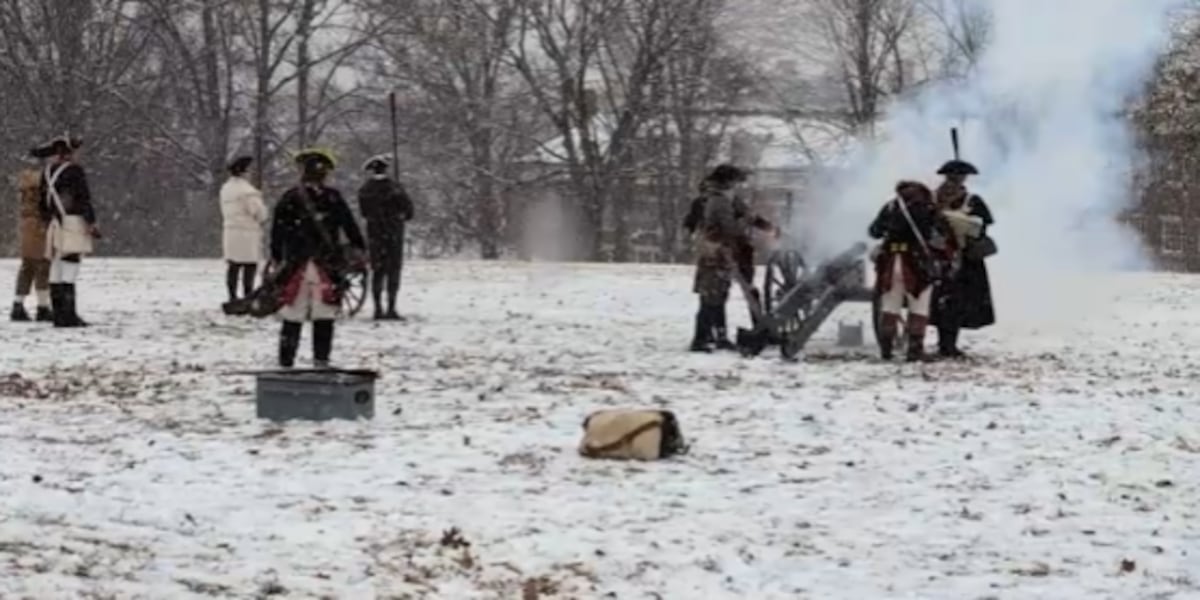
WESTFIELD, MA (WGGB/WSHM) -- In late 1775, Boston was under siege by British forces and the American colonists lacked the firepower to break the occupation. That’s when a 25-year-old bookseller named Henry Knox caught the attention of General George Washington and embarked on a mission that would change the course of the American Revolution.
Knox had joined the American Revolution earlier in 1775 and quickly impressed Washington, who sent him on a daring and dangerous mission: travel to the recently captured Fort Ticonderoga in upstate New York and haul 60 tons of formerly British cannons through 300 miles of wilderness in winter back to Boston. “So what’s happened is the battle of Lexington and Concord, Bunker Hill has happened, Boston, at the moment in 1775, is under siege. The British troops, the royal troops are inside Boston. George Washington and his army are surrounding Boston, but they can’t get in,” said Kanisorn Wongsrichanalai, chief historian at the Massachusetts Historical Society.
Knox began what became known as “The Noble Train of Artillery” in late 1775, spending eight weeks moving through the wilderness of New York and eventually Western Massachusetts. Teams of oxen and horses, along with hired men, pulled sleds of artillery across frozen rivers and rugged terrain over the mountains of the Berkshires.
Knox recorded his journey in a diary. One entry dated January 13, 1776, from Blandford, showed Knox contracting with Solomon Brown to carry a cannon weighing 24.5 pounds from Blandford to Westfield, a distance of 11 miles, for 18 shillings. “It’s a really remarkable, logistical feat and it demonstrates not just the will Knox has to accomplish this, but also the logistical and organizational skills that the Americans have. I mean, hey, the American Army is not much of an Army in 1775. It’s puny and it’s about to take on the most powerful military force on Earth,” Wongsrichanalai explained.
Downtown Westfield features one of 56 markers along the Knox Trail, placed in 1926 to celebrate the 150th anniversary of the journey. The marker reads in part: “Through this place passed General Henry Knox in the winter of 1775-1776.”
By late January 1776, Knox and his cannons reached the outskirts of Boston. The artillery was placed on the high ground of Dorchester Heights, making the British position untenable and leading to their evacuation. “If we think just about Knox rescuing his town and all the people along the way who are also trying to rescue their colony – their state – and their new nation that’s coming together, this is a critical moment. It demonstrates skill, it demonstrates the ability for the American forces to be a threat to British forces, and it liberated Boston. It liberated New England for the rest of the war more or less,” Wongsrichanalai noted.
Knox remained friends with Washington throughout his life, serving in his cabinet as the nation’s first Secretary of War. He also remembered his time in Western Massachusetts, choosing Springfield as the site of the nation’s first armory.
Copyright 2026 Western Mass News (WGGB/WSHM). All rights reserved.
Read the Original Article
This article was originally published by Western Mass News. Click below to read the full article on their website.
Visit Western Mass News