
Leverett voters back conservation trail, keep historic library
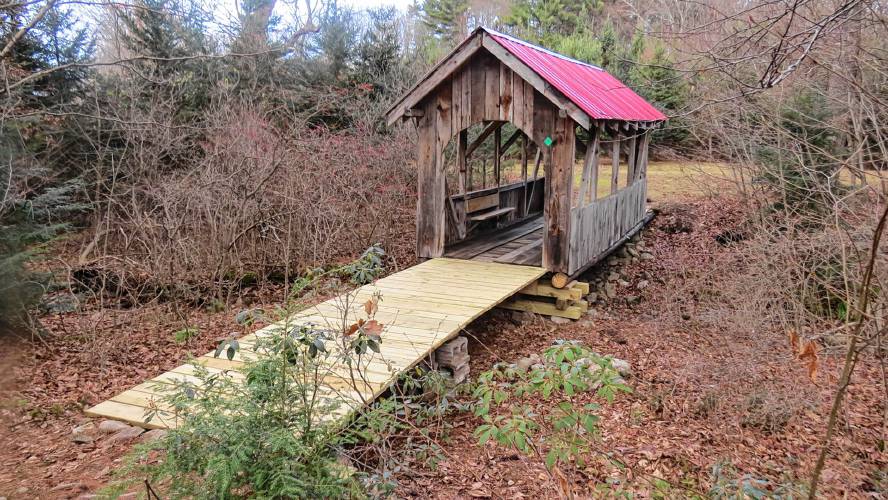
LEVERETT — Voters at annual Town Meeting last Saturday approved a new drivable trail that will provide access to conservation land on a former Christmas tree farm, possibly bringing an end to a Land Court lawsuit that has kept the public from using the main Shutesbury Road trailhead.
The $100,000 from the Community Preservation Act account to permit and build the 600-foot path from Woodard’s Corner to the so-called Blueberry Patch received support from residents who came to the session at the Leverett Elementary School gym.
Voters also agreed, in a near unanimous vote, to keep the former Bradford Field Memorial Library in town ownership, while giving town officials two years to figure out a plan and solicit grants that might be available for allowing more uses at the historic 1 Shutesbury Road site. The other option presented to residents, after a committee did extensive study and held two listening sessions, was to sell the building.
Select Board Chairwoman Patricia Duffy described the meeting as going “almost perfectly smooth,” with some discussion and debate throughout the day. Voters approved an $8.45 million budget for fiscal year 2027, that represents a $355,758, or 4.4% increase, over this year’s $8.1 million budget.
The spending plan preserves most existing services without need for a Proposition 2½ tax-cap override. Spending for the elementary and regional schools combined will be $5.43 million, up $290,318 over the $5.14 million being spent this year.
Another article allowed for the creation of a new Municipal Light Plant that would eventually establish a microgrid of solar power to supply the school, the Leverett Library and the Leverett Public Safety Complex. A second vote will be required on this next year.
Duffy said this would be similar to the town broadband network, which has its own Municipal Light Plant and is good forward thinking. She praised Planning Board members Richard Nathorst and Tim Shores for the presentation.
The discussion on the drivable trail came after last November’s contentious special Town Meeting in which residents were divided on taking by eminent domain a small portion of land from the Evans-Marlowe family. That family filed a Land Court lawsuit in June 2024 against the town and its Conservation Commission due to concerns about the public using a strip of land to get to the Blueberry Patch, also known as the Gordon S. King Life Estate.
There were some worries from a descendant about the trail impacting a neighboring property and whether wetlands would be affected, though any work would be reviewed by both the Conservation Commission and the Massachusetts Environmental Policy Act. The area where the trail would pass has been used as a place where people have dumped household trash, with an old television set put there.
Duffy said part of the discussion centered on whether this was a town need, or just a town want. She argued that having access to the land is a need because it provides a diversity of plants and birds, is a mowed area with fewer ticks and is flat so can be enjoyed by those with mobility difficulties.
Town Meeting also voted down two petition articles, including an appeal from Camp Road residents for the town to take ownership of the private way near Leverett Pond. Though many supported the concept, they asked for more information about the impacts on the town budget.
Voters also rejected a petition to use $200,000 in free cash to offset the tax burden for residents in the budget. Voters agreed with Finance Committee Chairman Phil Carter, who said it wasn’t good fiscal practice to use free cash to pay for operational expenses, which would leave a deeper hole next year.
Voters also agreed to accept a 25 mph speed limit in all thickly settled areas, which gives the Select Board authority to use this as a tool for dealing with speeding.
Read the Original Article
This article was originally published by Daily Hampshire Gazette. Click below to read the full article on their website.
Visit Daily Hampshire Gazette