
Navigating college with a rare metabolic disorder: How one UMass sophomore is finding her place at the dining table
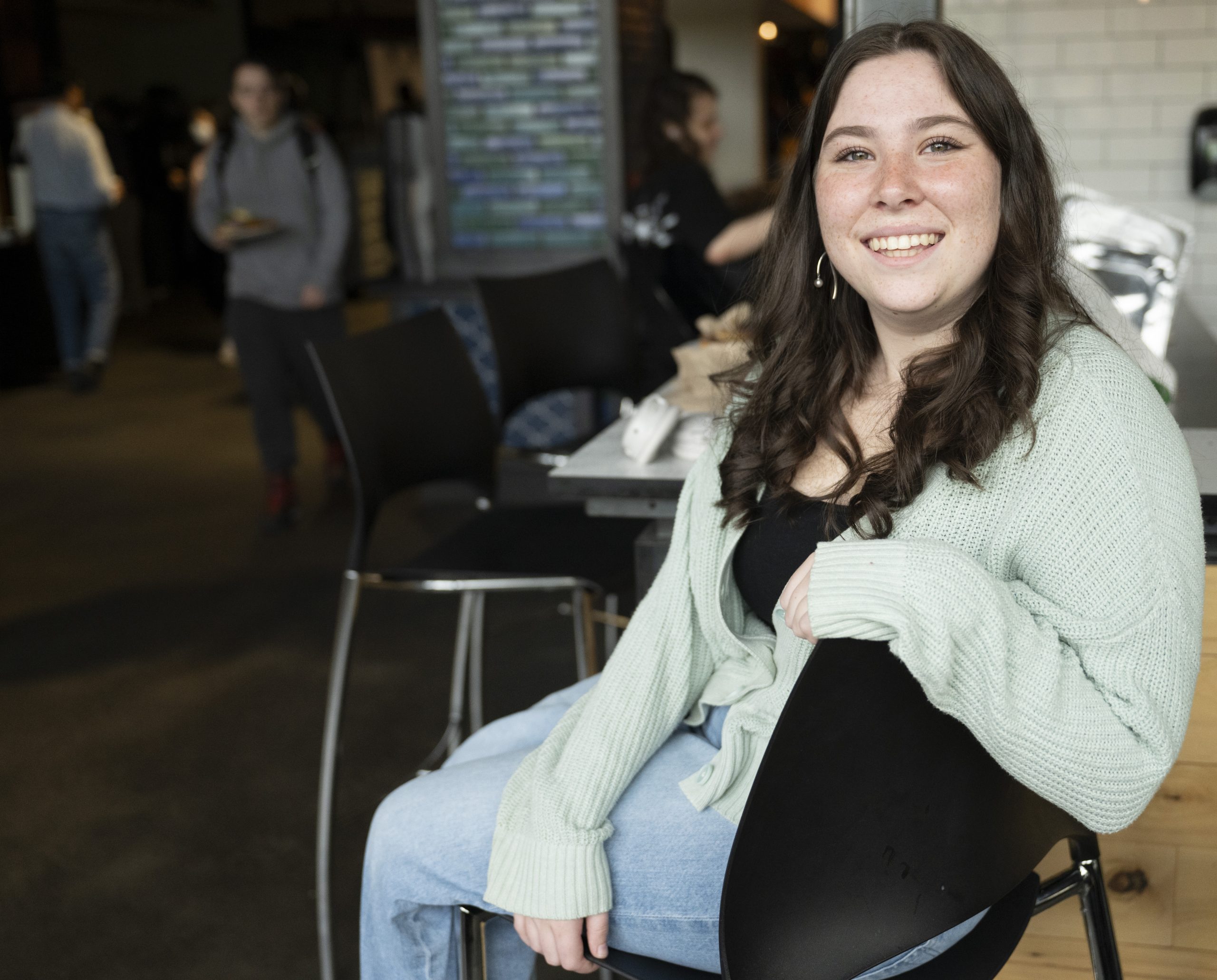
AMHERST — The aromas of freshly prepared meals waft through the University of Massachusetts Amherst dining halls, highlighting the wide array of food options available to students prepared by the Dining Services cooks and chefs throughout the day.
Yet even though Emma Friedl, who recently completed her freshman year, is a regular at the Worcester Dining Commons, the conventional food being made and then served to her peers is something she has to avoid.
“I can’t eat anything in the dining hall,” Friedl said. “There’s not a single option here for me.”
Instead, within a three-hour window each day, Friedl stops at a counter inside the dining commons to pick up specially prepared meals that meet her strict dietary needs.
She is one of an estimated 13,000 to 14,000 Americans who have been diagnosed with phenylketonuria, or PKU, a disorder that severely limits one’s intake of natural protein to around 8 grams per day, the protein equivalent of about two eggs, or a scoop of peanut butter.
The disorder affects the body’s ability to break down the amino acid phenylalanine, or Phe, which is present in most foods, such as dairy products, meat, fish, eggs, legumes, grains and some fruits and vegetables. Besides significantly limiting protein in their diet, those with PKU rely on low-Phe foods and supplement their nutrition with medical formula to obtain the essential proteins the body needs to function. That milkshake-like concoction safely gives her 90% of her protein intake.
Though PKU is not a regular physical illness, Friedl can sometimes tell when her Phe levels are elevated. That’s why every meal is measured, calculated and planned to keep blood Phe levels in a safe range and prevent buildup that can result in cognitive defects and neuropsychological complications.
“The more you go off diet the more it hurts your brain,” she said. “This is a lifelong disorder.”
Friedl also works directly with a dietitian and others and then uses an app to order meals for the next day. “They know what’s in my inventory,” she said.
Friedl praises UMass Dining for then making her special medical meals — breakfast, lunch and dinner — which are stored in two dedicated warmers and a freezer just for her. The meals are crafted from mostly lab-based food with no real nutritional content, though an effort is made to come up with meals akin to low-protein pastas and low-protein tortillas.
“They try to make it as close to regular foods as possible,” Friedl said, adding that the food is needed to combat hunger.
She said UMass is already adept at this from its allergy meal program that works for anyone with serious allergies, and played a role in her decision to enroll at UMass.
“I knew I wanted to be a nutrition major, I focused on UMass because it has one of the best nutrition programs in the country,” said Friedl, a native of Longmont, Colorado. “And I’d never been to Massachusetts, but loved the idea of being in Massachusetts.”
Friedl explains that her parents’ health insurance covers the cost of the food and there are regular check-ins with the company to see how much is left and available.
Friedl said coming to UMass, nearly 2,000 miles from home, to study has been her parents’ philosophy of never allowing PKU to hold her back.
Kathy Friedl confirms this is exactly what she hoped for her daughter.
“We wanted her to be where she wanted to be, and we didn’t want PKU to be a deciding factor,” Kathy Friedl said.
While touring college campuses, the family reached out to disability services to ensure Emma would be well accommodated. What they found is UMass already has a great process for serving any students with allergies and metabolic disorders.
“It has allowed her to have a more normal college experience, to go to dining commons with her friends and to be in a normal dorm room,” Kathy Friedl said. “It felt that was important for her socially in her freshman year.”
“I feel like it’s been a great experience, that she’s loved being at school,” she adds.
Born in 2007, Emma Friedl was Kathy Friedl’s third child. About six days after her birth, a pediatrician informed the parents that the newborn screening revealed the PKU disorder. With no known family history, the Friedls were completely unaware of PKU until they learned they were both recessive carriers of the gene.
“It was a complete surprise,” Kathy Friedl said.
And from quickly browsing the internet, they learned about the potentially scary consequences that could include severe brain damage. “It was doom and gloom; it was scary,” she said.
They met with a geneticist and metabolics team and had another test, finding out about the restricted diet for their baby. A medical formula was given and she was monitored closely with blood draws every other week. By the time she turned 5 or 6, there were monthly blood draws, with treatments focused on managing Phe levels and supplementing enzyme function.
Children’s Hospital Colorado would do group clinics with all PKU youths.
“It was a positive for Emma to meet other kids with the disorder,” Kathy Friedl said. “It was also an opportunity to learn a lot about diet, the ‘yes’ foods and the ‘no’ foods.”
“She was pretty good about maintaining the low-protein foods,” Kathy Friedl said, recalling how Emma understood as early as preschool that other children could eat hot dogs while she could not.
But she kept things positive, initially having lunch packed at home. By third or fourth grade, the schools were able to offer low-protein foods and would attempt to match, as closely as possible, the meals other students were eating. This continued through middle school.
“It’s worked well for her in managing her PKU,” Kathy Friedl said
Emma Friedl continues to get her blood drawn by University Health Services and sends the samples, by FedEx, to have them read through a patient app. Sometimes Phe levels go up, but she’s done a good job of keeping in the range.
“Our philosophy is it shouldn’t limit here. It’s always something in consideration, it’s something you have to plan and it’s sometimes difficult with diet,” Kathy Friedl said. “She’s just a busy college kid.”
For now, the diet is what she termed the “gold treatment.”
“We’re excited about therapies being investigated at this point,” Kathy Friedl said.
Aside from using a specialized website and distributor to access foods, there are some that can be bought at regular grocery stores, such as dairy-free cheeses and some gluten-free products.
And if she forgets to place an order, Emma Friedl said she feels bad.
“Sometimes it’s hard because I feel like I’m inconveniencing them, I’m hesitant to reach out if I missed an order,” she said.
But it’s also different from an allergy, where those people can have other foods. “My food is no harder to cook than anyone else’s,” she said.
Returning for her sophomore year this fall, Emma Friedl is on an accelerated track toward a master’s degree, focusing on general nutrition, sports nutrition, and nutrition science.
She also will be in an apartment where she will be cooking her own food shipped from the lab, not worried that she will no longer be frequenting Worcester Dining Commons in the same way.
“I’ve been cooking my own food for a long time,” Friedl said.
Read the Original Article
This article was originally published by Daily Hampshire Gazette. Click below to read the full article on their website.
Visit Daily Hampshire Gazette