
Northampton Planning Board begins review of 91-unit King Street housing proposal
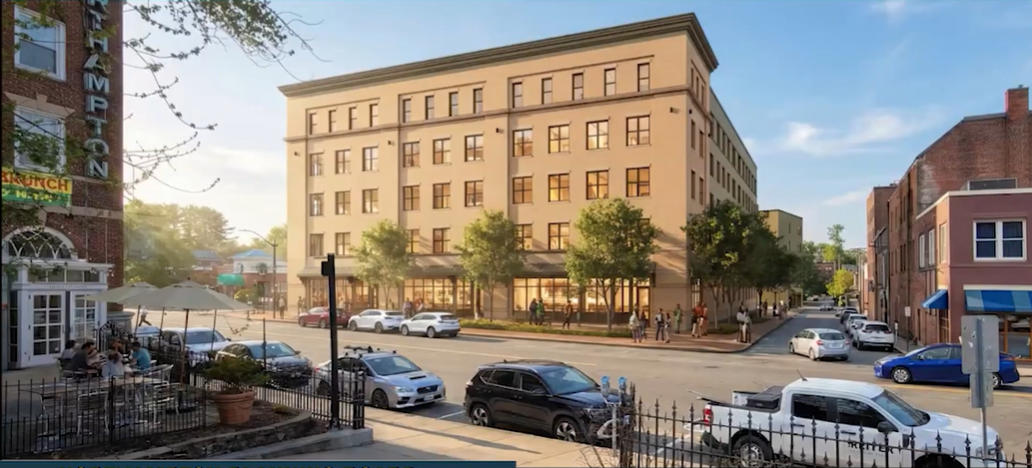
NORTHAMPTON — With questions lingering over parking, pedestrian access and design standards, the Planning Board has continued its review of a proposal to build 91 affordable housing units downtown at the former Registry of Deeds site on King Street until next month.
In a more than four-hour meeting last Thursday, designers and architects working with co-developers Valley Community Development (Valley CDC) and The Community Builders (TCB) presented plans to build two five-story buildings on the 1.46-acre downtown property at 33 King St., next to the closed Calvin Theater and across from Hotel Northampton.
The current building on the property, constructed in 1975 and vacant since 2019, would be demolished to make way for the new development, and each building would be owned separately by the two organizations.
Kuhn Riddle Architects and Designers President Aelan Tierney, addressing the Planning Board, explained that the Central Business Architecture Committee approved the project a week earlier. Should the Planning Board approve a permit for the project, she said construction is expected to start in 2029 and be completed in 2030.
“This design and development team has been working hard to create a design that meets all of the rules and regulations of both the city and state, as well as funding requirements, is a pleasant place for residents to live [and] incorporates a design aesthetic that blends with the historic nature of downtown while also having some independent character,” Tierney said, referring to the buildings as “siblings, but not twins.”
She explained, “You see the lively storefront and pedestrian character of the TCB building along King Street, with a glimpse of the main entry to the Valley building beyond.”
Plans filed with the city call for the Valley CDC’s nearly 52,000-square-foot building to be constructed first at the back of the property, next to the Norwottuck Rail Trail. Valley’s building will be a mix of one-, two- and three-bedroom units, with common space on the ground floor and laundry rooms on the upper floors.
The TCB 62,000-square-foot building will sit at the front of the property on King Street, containing 14 one-bedroom and studio units, 18 two-bedroom units, and four three-bedroom units alongside a ground-floor commercial space.
The board mulled over abutters’ concerns that construction would block bike trail access and limit parking in the neighborhood. Members also considered whether the two proposed buildings’ ground areas — one taking up slightly greater than 10,000 square feet and the other surpassing 12,000 square feet — meet the criteria for site plan review.
Tierney explained that the site’s location in the Central Business Zoning District does not require a minimum parking count, noting that the site’s 29 resident parking spots will be distributed using a lottery system. Still, some Ward 3 residents, such as Daniel Breindel, argued that the site lacks sufficient parking.
“Some of these units are going to be multi-bedroom units — that’s a family — that can be two cars,” Breindel said. “We heard words like ‘lottery’ and ‘wait-list,’ that means there will be a wait-list … if you have that many units, and that many people coming to this area, where are their cars going to go?”
In deliberations over the site’s parking concerns, Planning Board members largely expressed comfort with the scale of the parking. Member George Kohout argued that just as residents of other larger apartment complexes in the city have found places to park, so will those of the King Street development.
Resident Alex Bowman, who owns the 17-25 Market St. parcel, questioned whether the development would hinder residents’ access to the rail trail through the entryway near Merrick Lane.
“Merrick Lane is the only city-owned accessible rail trail ramp for a quarter mile in either direction, making it a primary access point for downtown residents and visitors,” Bowman said. “It is contradictory for the board to waive the minimum pedestrian scale design requirements that exist to serve the 200 new residents who will depend on it. This design uses a limited easement over a public way on someone else’s property that is used as a private driveway instead of using a public way.”
When asked if improvements could be made to create easier access to the bike path near Merrick Lane, Senior Project Manager Emily Wright of Fuss & O’Neill engineering firm, said accommodations could be made if it was a “priority for the community.”
As 11 p.m. approached, the board voted unanimously to continue the hearing to July 9 and requested that the applicant return to discuss zoning waivers for crosswalk and pedestrian safety, light spill-over, planting plan and design guidelines for the Merrick Lane Facade.
“My read on things is that generally, there is a lot of support for and interest in this project,” Planning Board member Janna White said. “[We’re] grappling with wanting to make sure that we’re applying the standards as they’re written and those design standards down Merrick are a sticking point.”
Read the Original Article
This article was originally published by Daily Hampshire Gazette. Click below to read the full article on their website.
Visit Daily Hampshire Gazette