
The story behind Connecticut’s northern border notch
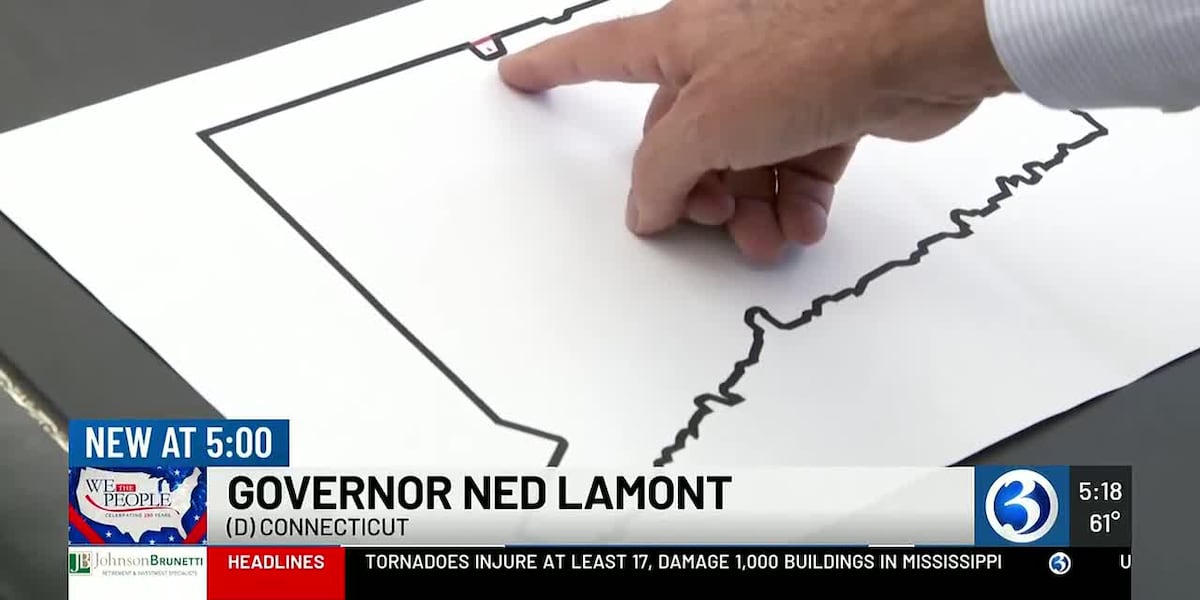
GRANBY, Conn. (WFSB) - A peculiar dip in Connecticut’s northern border has puzzled map readers for generations, but the story behind the Granby Notch goes back more than 380 years.
The notch, also called the Southwick Jog, appears as a bite-size piece cut away by Massachusetts along the state line.
Gov. Ned Lamont said the unusual border stems from a surveyor’s mistake in 1642.
“Back in 1642, our surveyor made an error. And we’re convinced that this eight-mile jog right here belongs to Connecticut. But I’ve got to work on that with Maura Healy, because Massachusetts has claimed it for themselves, going back about 400 years,” Lamont said.
The mistake lingered for decades, while additional surveys only caused more animosity. Connecticut finally accepted a compromise in 1804.
Today, the line is drawn along the Congamond Lakes in Southwick.
Dan Curran, who works at Congamond Coffee in Southwick, lives in Massachusetts and stays away from Connecticut.
“I just don’t visit. I don’t know. You know it’s right down the road. I stick to my side, though. That’s it. You’re right here. And that’s all you need,” Curran said.
Steve and Susan Basile are from Granby and cross state lines, even visiting the notch area.
“My brother was a geologist, and he said if you look at the Notch, and the mountain range that comes down, think about when the Ice Age came to, it was a mile higher than what you’re looking at now, so you can imagine what it must be like a geologic area. It’s really interesting,” Steve Basile said.
Lamont reached out to Massachusetts Gov. Maura Healey about the border.
“Maura, I want you to see this little blip right here. It should be a straight line, the northern border of Connecticut. But instead, you have something called the Southwick Jog. You’ve annexed eight miles of our property. Just saying, maybe it’s something we ought to work out together,” Lamont said.
Healey responded that the matter was settled.
“Hey Ned, listen, I hear you. But I’m not sure if you know this. When Connecticut signed the paperwork back in 1804, you actually locked in an age-old clause that we’re still bound by today. It’s called, no takesies backsies,” Healey said.
While Massachusetts got the notch, Connecticut got Suffield, Woodstock, Somers and Enfield in the border settlement of 1804. All four towns left Massachusetts because of high taxes.
Lamont said he is not willing to give them back.
Copyright 2026 WFSB. All rights reserved.
Read the Original Article
This article was originally published by Western Mass News. Click below to read the full article on their website.
Visit Western Mass News