
What are your rights when ICE comes to your door? Experts weigh in after recent deaths
SPRINGFIELD, Mass. (WGGB/WSHM) - Two deaths in ICE enforcement operations this month has raised urgent questions about federal agent authority, but many wonder what an ICE agent is, what they can and cannot do, and what are one’s rights.
When ICE shows up at your door, what do you do? It’s a question Rebecca Hamlin is asking herself every day as a professor of legal studies and political science at UMass Amherst. “People are afraid…People who are undocumented are certainly terrified to leave their homes, to go to work, to send their kids to school,” she said.
However, it’s also a question that is harder to answer every day. “Even people who are not are also very afraid, because it does seem right now like in the enforcement actions that we’re seeing...People are being stopped just based on, oftentimes, the color of their skin,” Hamlin added.
Hamlin has been studying ICE agents’ interactions and deportations for several years. When it comes to precedents, she explained, “So this is pretty unprecedented...They’re not committing crimes, they’re not hurting anyone. Previous administrations have really just prioritized people who have criminal records.”
Retired ICE Agent Albert Olowski now lives in Massachusetts but, before 2014, he worked for ICE for over 20 years and said he saw what agents are really like. “Entering the country without inspection is a crime. As a sworn law enforcement officer, you have to enforce the laws. If the general public doesn’t agree with it, contact your congressman,” he said. “They got families. I mean, they have children. They have marital issues. They got financial issues.”
As for the basic question of whether ICE agents are members of the police, they aren’t, but they are law enforcement officers. If you call 911, an ICE agent won’t answer, but they can detain you if you’re in the country illegally.
How do they know who is undocumented? Hamlin says they’re supposed to just ask and believe what you say, which begs the question of how do they pick who they ask and that’s where things can get tricky. “They are technically not supposed to engage in racial profiling, but they do, they are allowed to do more complicated kinds of profiling...including things in combination, like someone’s race, if they have an accent, the neighborhood that they’re in,” she noted.
Orlowski added, “When I worked, I never racially profiled. We received a memorandum not to racially profile and we never racially profiled,” while Hamlin explained “It doesn’t seem like the protocol is being followed that has been followed in the past and so people are worried.”
ProPublica data shows ICE agents have detained almost 200 U.S. citizens in the last 12 months, at least 20 of which said they were held for over a day. “You can suffer. You know, you can be, you know, mistreated in various different ways and there really isn’t much recourse at the end of the day if that happens to you,” Hamlin said.
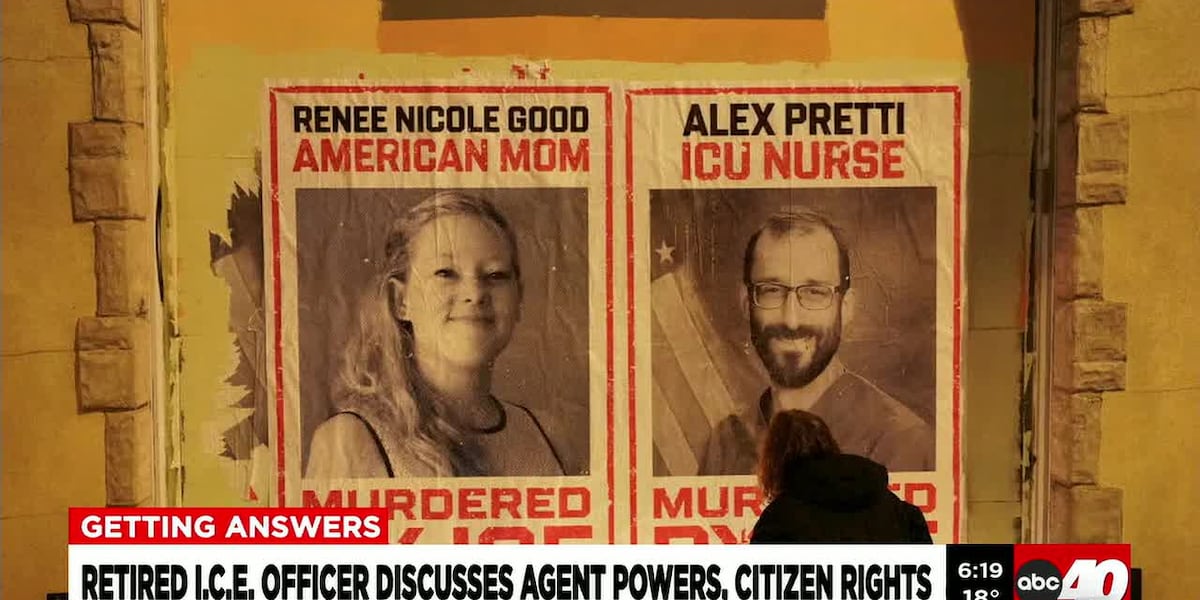
That suffering is a real focus of the conversations about ICE agents, especially since the death of protester Renee Good. “He’s looking at her. He’s focused on her and that vehicle keeps coming. He’s trying to hopefully she’ll be smart enough to put the brakes on...it happens so fast,” Orlowski explained. “It’s a split second. You’ve got a split second to make a decision...If you feel your life is in imminent danger, you have the right to use deadly force. He used deadly force and, unfortunately, she died. I mean, it’s a tragic incident, but it happens.”
Hamlin noted, “From what I’ve seen from the videos that I’ve watched, it did look like she was shot while fleeing the scene.”
Good’s death on January 7 was the first of two in Minneapolis, MN in the same month. On January 24, a border protection officer, who is under the same federal agency as ICE, killed ICU nurse Alex Pretti. Both shootings are now under investigation.
The New York Times verified videos that seem to contradict the government’s position about Pretti’s death. The Department of Homeland Security put out a statement that said Pretti had a gun, which he did. However, video reportedly shows he was holding a phone, not the gun, before the agents took him to the ground and shot him. Approximately eight seconds after they pin him, an agent yelled he has a gun, indicating they may not have known he had it until they had already used physical force. “I mean, I’m not defending the agents for doing it, but I’m saying that if you didn’t bring a gun, you probably would be home right now,” Orlowski said.
When Hamlin was asked, based on her knowledge and past movements within immigration, whether it be in the U.S. or around the world, how this time period will be remembered in the future, she added, “A lot more people could end up being killed...or it could be a flashpoint that leads a lot of people to say, this is not okay with me...We’re living history right now. We’re the deciding factor.”
Hamlin said if an ICE agent comes to your house, you don’t have to let them in unless they have a warrant.
Copyright 2026 Western Mass News (WGGB/WSHM). All rights reserved.
Read the Original Article
This article was originally published by Western Mass News. Click below to read the full article on their website.
Visit Western Mass News