
Speaking of Nature: Embracing the fledgling frenzy: Witnessing baby birds following their parents around in a state of unbridled excitement
Father’s Day just happened to coincide with the first day of summer this year, and the morning of Sunday, June 21, was just about as perfect as one could want. Cool air and bright sun produced a morning of utter splendor, which was then improved in its quality by a chanced to sit on the back deck and sip coffee with love ones. Then, if you can imagine, it was improved further still by the appearance of fledgling birds following their parents around in a state of unbridled excitement. The world is now overflowing with baby birds.
When I returned to my own home, I discovered that the same thing had happened. Where once there were nothing but adult birds — determined and working with purpose — there was now also a host of ridiculously adorable fledglings. Old enough to fly, but not old enough to understand much of anything except mommy, daddy and food, these youngsters were an absolute riot.
Any parents out there need only reflect back upon that fateful day when one of you own children was happily walking through the aisles of your local grocery store when, innocent of the insanity of the situation, that little darling decided to start climbing up the shelves. After all, there are interesting things up there, so why not go investigate?
Some baby birds are easily identified by their plumage, while others are such perfect copies of their parents that you must rely on behavior to try to figure things out. Sometimes the babies are cleaner in their appearance. Sometimes they still retain a small vestige of the extra skin at the corners of their mouths that helped the parents to guide food into their ravenous maws. And then there is the fact that many a fledgling seems to somehow wear upon its face the expression of vacant enthusiasm. Furthermore, there is also the curiosity inherent in the young. Baby birds often spend time scrutinizing the most mundane objects while they impatiently wait for someone to bring them some food.
It is this moment of the breeding season that is the most chaotic for the adult birds. Building a nest is no big deal, and it might actually be somewhat satisfying. Imagine designing a new bedroom in your house and making sure that everything is tidy, clean and perfect. Then add some eggs into the nest. This doesn’t take much time for the female, but there may be a slight increase in the levels of alertness and anxiety as more and more investment is put into this secret place.
But nothing can compare to the utter chaos of having four to five toddlers exploding into the world all at the same time. Keeping track of their random movements while also finding and delivering food must bring the adult birds close to madness. The only thing that can alleviate some of this pressure is a well-stocked feeding station next to some trees. If an adult bird can play the role of Pied Piper and lure its offspring to a place where there is abundant food and structural safety, then there is a chance that a smidgen of sanity can be saved. This requires that the youngsters are able to understand that their parents are going to find food and that they themselves are flying competently enough to follow them. Once such a family arrives at the feeding station on my deck, they rarely seem to leave.
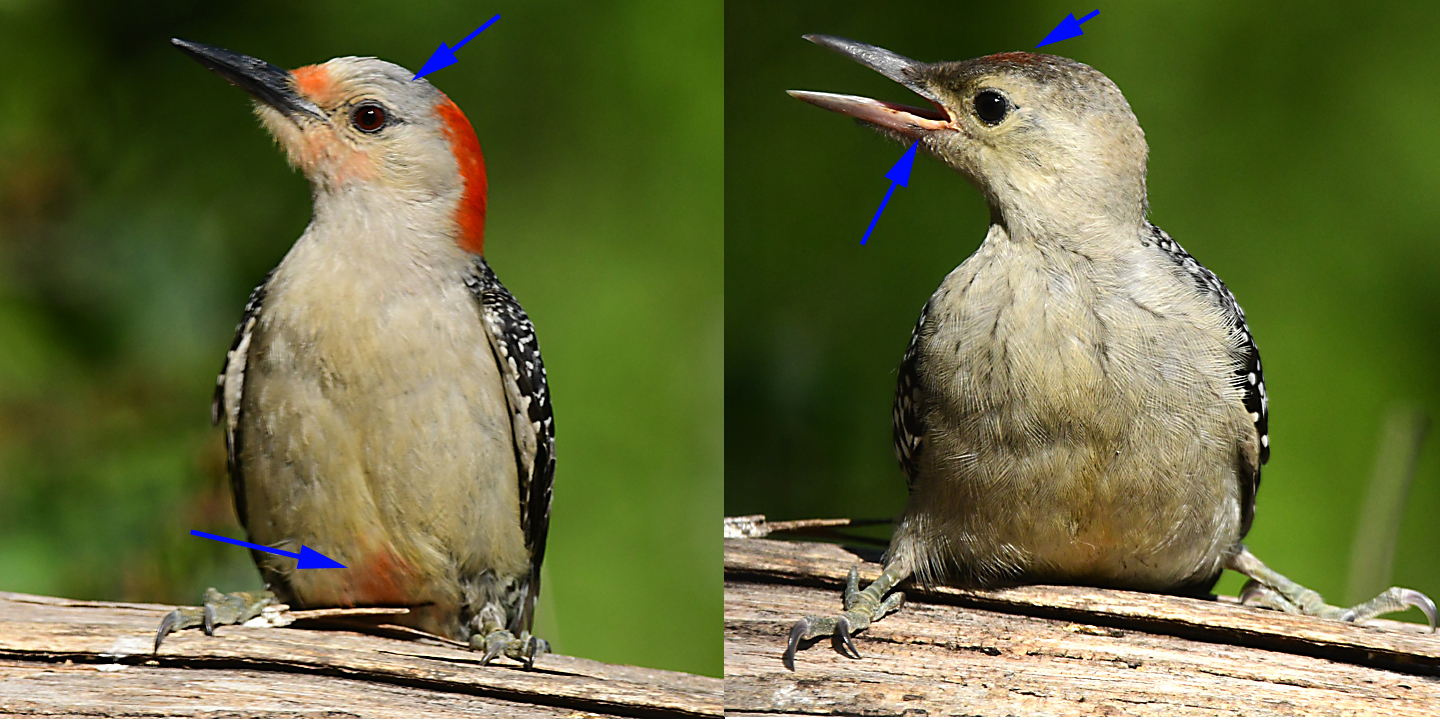
So, it is with great pleasure that I introduce you to my resident female red-bellied woodpecker and one of her new sons. I initially thought that I was very lucky to not just catch a glimpse of this young bird, but also take his photo. I didn’t realize that just a moment later his bedraggled mother would stop and perch in almost the identical spot that he had occupied. What luck!
On the left side of today’s composite photo you see the adult female. She can be distinguished from her mate by the patch of gray feathers directly on top of her head. An adult male has red feathers that extend from the base of his nose all across the top of his head to the base of his neck. You can also see that rather delicate wash of red feathers on her belly right between her feet. It is this patch of feathers for which the species is named. The name red-headed woodpecker was already given to a different species of woodpecker that has a full cowl of red feathers that covers the entirety of its head down to the base of its throat and neck.
On the right side of the photo you see a juvenile male red-bellied woodpecker. Note the awkwardness of the youngster’s stance with the feet placed too far apart. Then notice that the youngster’s head is covered with scruffy gray feathers that noticeably narrow at the neck. Then, note the thin wash of red on top of the bird’s head just above the eyes. This is the hint that this baby is a male. Young females do not have any red on their heads. Finally, there is just a trace of extra yellow skin at the corner of the young bird’s open mouth. This is a feature on many baby birds that allows the adults to cram irregular food items into open mouths with a little more accuracy.
So, for the next week or so there will be a huge increase in the number of birds flying around the landscape. At some point the adult females will hand off the baton of responsibility to their mates while they themselves start the process of making another nest. Then, for some species, there will be a second wave of fledglings that appear sometime in August. Others, faced with the need to migrate south before winter arrives, will forego a second nest and prepare for their vacations. Enjoy the mayhem while it lasts!
Bill Danielson has been a professional writer and nature photographer for 28 years. He has worked for the National Park Service, the US Forest Service, the Nature Conservancy and the Massachusetts State Parks and he currently teaches high school biology and physics. For more information visit www.speakingofnature.com, Speaking of Nature on Facebook, or the Speaking of Nature Podcast.
Read the Original Article
This article was originally published by Daily Hampshire Gazette. Click below to read the full article on their website.
Visit Daily Hampshire Gazette