
Speaking of Nature: Flocking to the sweet stuff: Backyard woodpeckers develop a taste for nectar
Even when one pays close attention to the events transpiring outside, there are details that can go “unseen” for a while. You might see something without taking a moment to let it “land,” and then it becomes difficult to really nail down when something that is relatively new started to happen. I do my best to see things, recognize them for what they are, and then write them down so there is an official record, but even I come up short now and then. It’s that last step — adding notes to the official record — that usually trips me up.
For many years, my mother and father have had a menagerie visiting the hummingbird feeders in their yard. These feeders always attract a certain amount of interest from bees and wasps in the late summer and early autumn, but for the most part they remain hummingbird feeders. Then, an enterprising species of songbird will poke around and discover that the sugar water held within is a valuable resource. Sometimes, this can lead to a culture of sorts that develops with particular birds in particular places.
At my parents’ house, this happened multiple times with multiple individuals of multiple species. The first bird to figure it out was a male Baltimore Oriole. Then, in fairly short order, a female oriole started sipping the sweet nectar on a regular basis. This is all fairly predictable and I have even seen nectar feeders that are modified for orioles. On the grand scheme of things, orioles at hummingbird feeders aren’t that unusual.
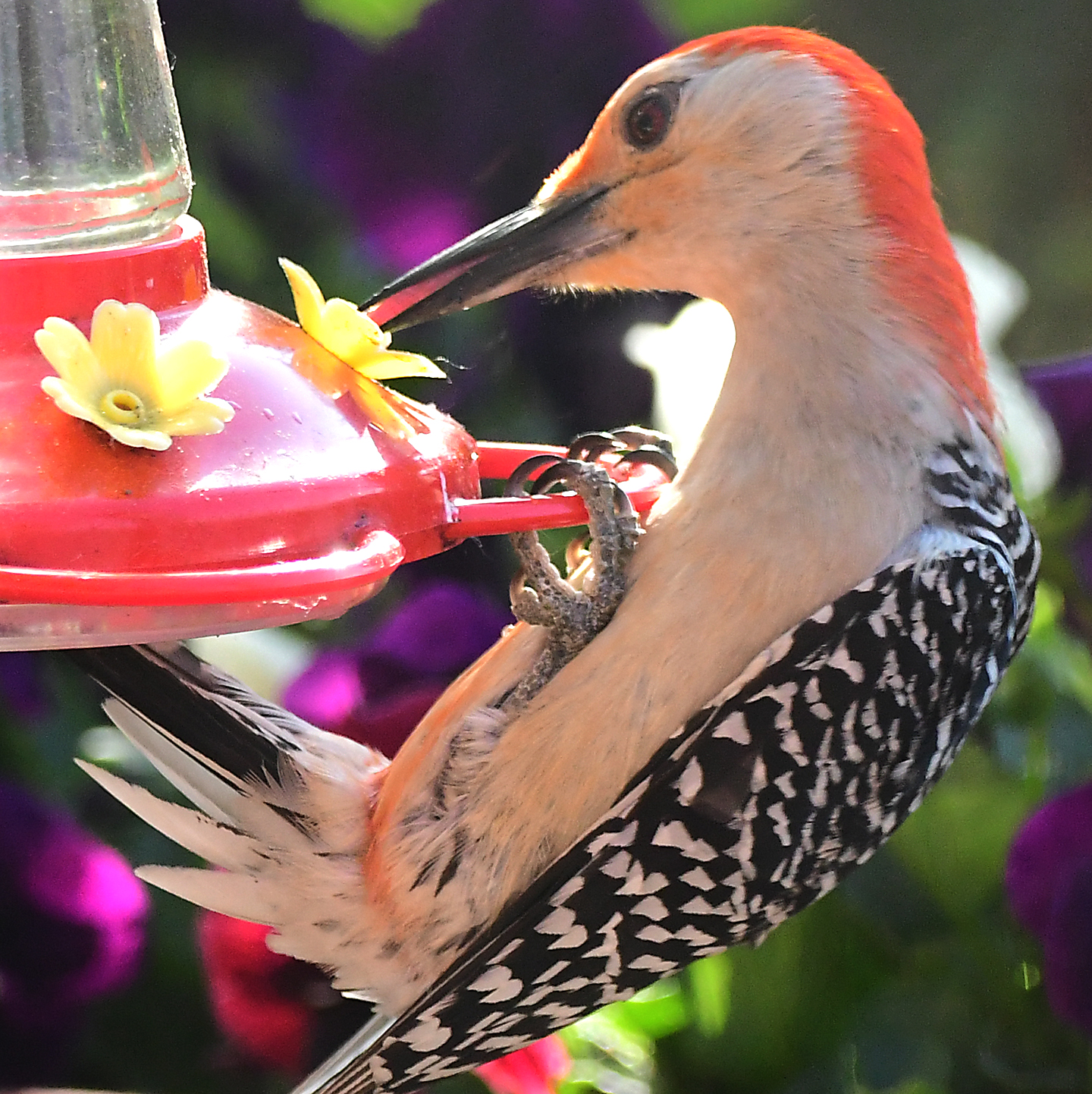
But then other species seem to pick up on the availability of food, presumably by watching and copying the orioles; this has happened at my parents’ house, and they now have a collection of woodpeckers and other species that pay regular visits to sip the ambrosia so generously provided by humans.
For years, I watched this happening with tremendous envy. I had hummingbirds, but no other species at my feeders. Then, last year, something changed. As always, the hummingbirds were regular visitors at my feeders, but then some of the freshly fledged downy woodpeckers — stuffed full of peanuts by their parents and loafing around with nothing to do — started to land on one of the hummingbird feeders and poke at it curiously.
When the innocence of the very young was inevitably replaced by the boundary-testing behavior of older children, things became interesting. The fact that there was something delicious in the feeder became so well understood by these young woodpeckers that they began to try to figure out how to get it. Being woodpeckers, their efforts involved a great deal of jabbing and pulling on the fake flowers that serve as access points to the nectar within, and one of the feeders had fake flowers that were particularly vulnerable to the little birds. In fairly short order, they had managed to remove some of the flowers and began slurping up all of the nectar on a daily basis. I actually got the impression that they would become impatient if they had to wait for a refill. Oh, the entitlement!
So that was last summer. This year has started off with a massive increase in the number of birds visiting my “hummingbird” feeders. It began with two or three downy woodpeckers who must have been those rascals that figured it out last year. Then, out of the blue, an adult male Baltimore oriole joined them. To see the bright orange splendor of that bird has been a tremendous treat, but it seems that he had to get in line and wait his turn.
In addition to the downy woodpeckers and the Baltimore oriole, I now have hairy woodpeckers, red-bellied woodpeckers and possibly even a gray catbird raiding the feeders for themselves. There used to be a concern that the sugar water solution that I make for the hummingbirds would start to mold if it were left in the feeder for too long. Now, with so much business at those feeders, I am having a tough time keeping them stocked.
Please keep in mind that all of this “complaining” that I am doing is an attempt to accentuate the pure joy of the situation. The notion that there are small birds that are comfortable enough with my presence to remain where they are when I step out onto my deck — and then deliver a good scolding because I’m taking too long with their treats — is utterly delightful.
If you would like to try to attract some birds for a sugary treat, then here’s what you need to do. Buy yourself a hummingbird feeder. If possible, try to buy it from a local shop. You want to find a design that has a glass bottle, that is also easy to disassemble for maintenance. Boil some water, and then mix one cup of boiling water with one-quarter cup of white sugar. This will dissolve the sugar and disinfect it at the same time. Fill the feeder, hang in a prominent location and then watch.
Hummingbirds are likely to find the feeder in fairly short order, so they will be the ones to tip off the other birds that food is available. If possible, hang the feeder near a tree, or some bushes, so the other birds can approach the feeder without having to land on it at full speed. And then, wait. It took my woodpeckers 21 years to figure it out, so make sure you have a comfortable place to sit and watch while you wait.
Bill Danielson has been a professional writer and nature photographer for 28 years. He has worked for the National Park Service, the US Forest Service, the Nature Conservancy and the Massachusetts State Parks and he currently teaches high school biology and physics. For more information visit www.speakingofnature.com, Speaking of Nature on Facebook, or the Speaking of Nature Podcast.
Read the Original Article
This article was originally published by Daily Hampshire Gazette. Click below to read the full article on their website.
Visit Daily Hampshire Gazette