
Speaking of Nature: Hiding in plain sight: How an ilia underwing moth uses bright colors to escape predators
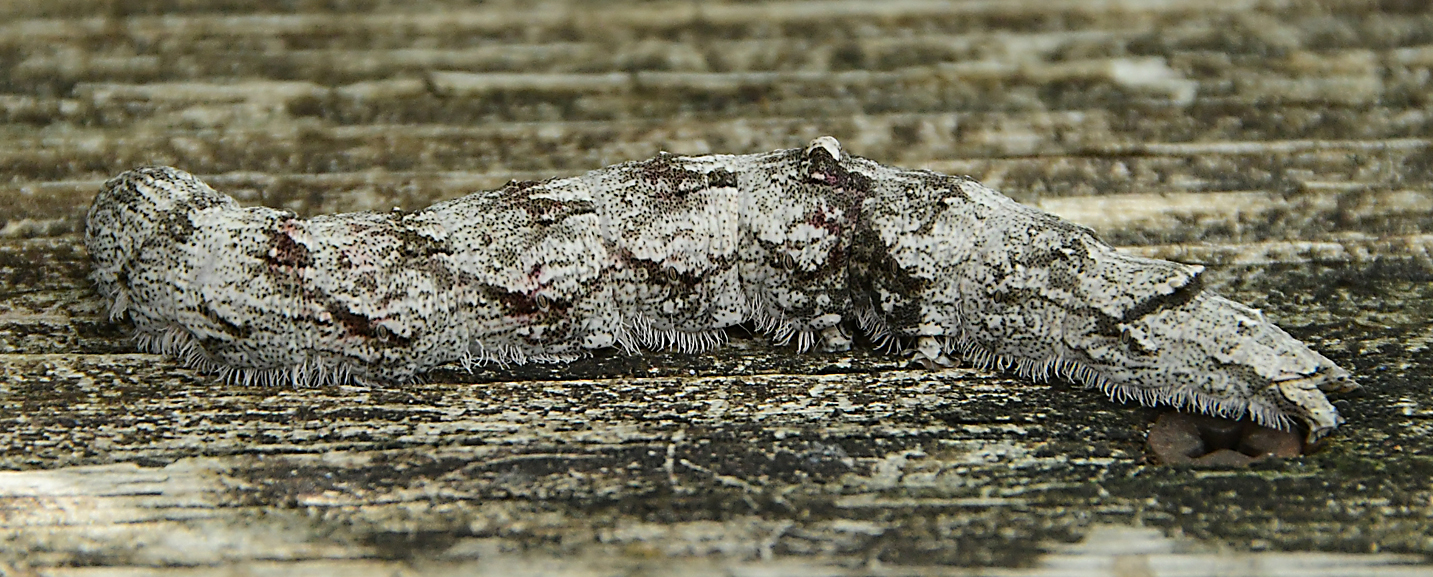
And now for something completely different. It was a beautiful Friday morning and my beautiful wife Susan was cleaning off our deck chairs in preparation for a morning of reading and coffee under our beloved cottonwood tree. Susan came into the house and said, “You’ve got to see this! Bring your camera.” This rarely happens, so I took her quite seriously.
I stepped out onto the deck, breathed in the fresh morning air, and then walked straight to where Susan was standing. As I approached her I noticed that she was standing at full alert and pointing to the deck. When I arrived and looked at the spot that she was pointing at, I was surprised to see a large, gray caterpillar lying there. Apparently, Susan had discovered it by accident while brushing off the chairs.
Before I go any further I really must commend Susan on the progress that she has made since I first met her. In those early days, a creature such as this might have sent her into orbit. She would have begged me to get rid of the thing and refused to step out onto the deck again until I had given an official “All is clear” message. But now, there is just a whisper of hesitation left in her. She certainly wasn’t going to touch it, but she was willing to watch as I attempted to pick it up.
As soon as I did this, the caterpillar ended up giving me a fright. Most caterpillars just sort of lay there and when you try to pick them up they might try to slowly curl into a ball to protect themselves. This particular creature was much more energetic. This one started to energetically thrash its body from side to side and this was enough to startle me and lose my grip on it. This is exactly what a caterpillar needs to do if a bird grabs it. One hesitation and the caterpillar might fall to the ground where it will be concealed by vegetation.
As the caterpillar continued to “fight back,” it rolled on its back and exposed a colorful underbelly with several large black spots. The thrashing behavior, the rolling onto its back, and the dark spots were enough to eventually allow me to offer up a possible identification for this thing. It took me a couple of hours to zero in on the fact that this was the larva of an ilia underwing moth (Catocala ilia).
This was definitely a first for me and with great care I managed to pick it up and gently place it on the deck railing. I took a few photos of the caterpillar as it attempted to blend in, but I wasn’t really interested in attempting to get photos of the underbelly. I was concerned that I might injure the poor thing in the attempt, and I had no interest in hurting it. So I took a few photos, put my camera back in the house, and joined Susan to do some reading in the dappled light under the tree. To her great credit, Susan happily pored over her own book and was totally unconcerned that the caterpillar was still there.
The ilia underwing moth is one of 75 different species in the Catocala genus in the Eastern United States. Adult underwings are fairly large (as moths go) and they are colored so cryptically that they almost vanish when they sit still on the bark of trees. This is how adult moths spend the daytime hours and I have to imagine that most are able to go undetected. However, should a predator stumble upon one of these sleeping moths there is a possible way out. The moth will suddenly open its wings and reveal a large expanse of bright color. Sometimes this is enough to give a moth that split second that it needs to escape. In the case of the ilia underwing, the color exposed is bright red.
One of the things that gave me so much trouble identifying the caterpillar was the fact that it just didn’t look exactly like any of the photos that I managed to find in the books from my private library. I started with a USDA publication called “Caterpillars of Eastern Forests,” and I actually gave a close look at the ilia underwing from the start. But the caterpillar that I had seen just wasn’t a perfect match. I searched online for a while, but didn’t have any better luck. Then I switched over to “Caterpillars of Eastern North America” (a Princeton Field Guide) and was again unsatisfied. It wasn’t until I typed “underwing moth on a cottonwood branch” that I struck gold. It turns out that there is a tremendous amount of variability in the appearance of individual caterpillars depending on what sort of tree they are trying to hide on. Go figure.
There is a tremendous amount of natural history that I could attempt to explain, but I want to close this particular column with a look at the names of some of these species. “Ilia” was the mythological mother of Romulus and Remus, and the naming credit goes to a Dutch entomologist named Pieter Cramer who lived in the late 18th century. It turns out that entomologists have a long history of naming underwing moths after feminine figures in literature, and the names certainly conform to that model. Here is just a selection of the names that I found in my field guides: the betrothed, the old maid, the widow, the oldwife underwing, the bride, the once-married underwing, the mother, the darling underwing, the sweetheart, and the girlfriend underwing. All are gray moths with patches of color waiting to scare away predators.
I hope that you are able to get outside and enjoy a cup of coffee with a good book this week. If that Canadian wildfire smoke will stay away, then there should be some pleasant, cool mornings that don’t cause coughing spasms in our collective futures. Just be sure to take a close look at your favorite seat before plunking yourself down. It is always possible that there is someone hiding in plain sight and it would be sad to hurt anyone.
Bill Danielson has been a professional writer and nature photographer for 28 years. He has worked for the National Park Service, the US Forest Service, the Nature Conservancy and the Massachusetts State Parks and he currently teaches high school biology and physics. For more information visit www.speakingofnature.com, Speaking of Nature on Facebook, or the Speaking of Nature Podcast.
Read the Original Article
This article was originally published by Daily Hampshire Gazette. Click below to read the full article on their website.
Visit Daily Hampshire Gazette