
How the Berkshire Bird Observatory is studying the secret lives of saw-whet owls
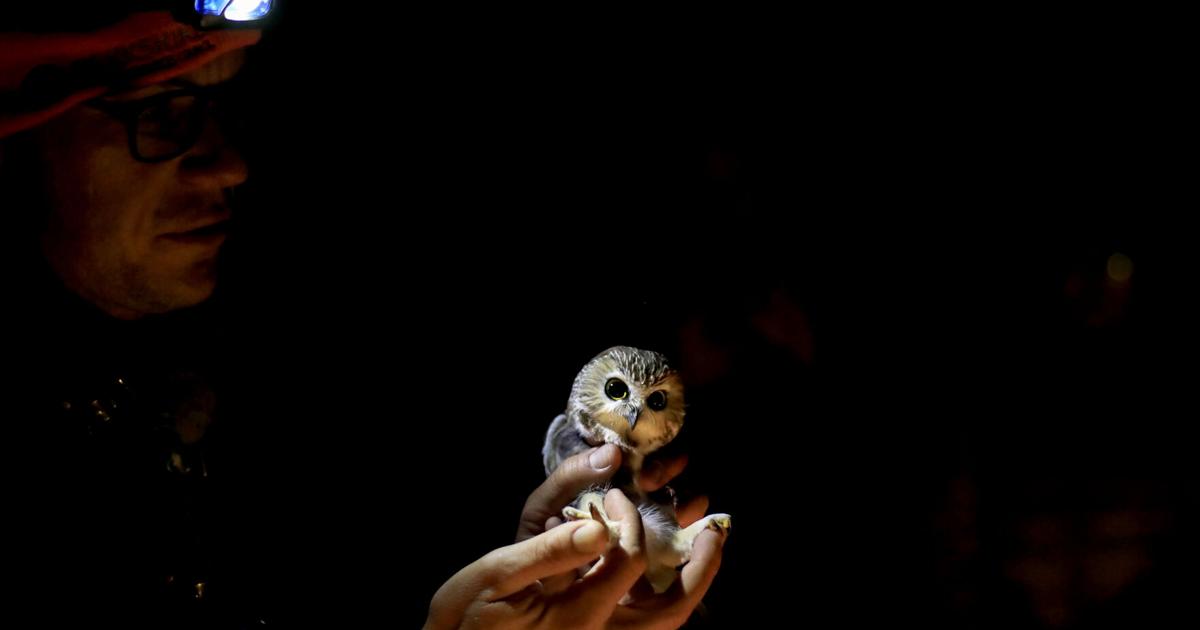
EGREMONT — “Awws” filled the quiet woods as Ben Nickley lifted a northern saw-whet owl from a cloth bag, giving 15 spectators a look at the mysterious, tiny bird under the lantern light.
“She's so cute,” spectator Laura Gratz said as the owl peeked from the bag.
From mid-October through early November, a team from the Berkshire Bird Observatory in Great Barrington hikes about a quarter-mile into the state’s Jug End Reservation and Wildlife Management Area roughly four hours after sunset to collect data. Their research focuses on the movements and population trends of the northern saw-whet owl, an elusive, small and adorable species that migrates through the area each fall.
They roost in evergreens or trees with thick foliage, and these nocturnal birds, the size of a small robin, also nest in cavities, making them hard to spot.
The data project is part of Project Owlnet, a collection of banding stations across the East Coast that share data with the U.S. Geological Survey in Maryland and with MassWildlife. Nickley, the observatory's executive director, and interns Sam Baxter-Bray, Kara Cole and Denali Krampe man one of the busiest banding stations in the eastern United States.
“It’s just one of the coolest things ever,” Cole said as she headed toward the station after checking one of the nets used to catch the birds.
A short hike from the banding station is where the owls are caught. Nets are set up in an X shape around a speaker that plays the male mating sound. The nets are only open on cold nights with north winds, the best conditions to capture.
Kara Cole and other researchers with the Berkshire Bird Observatory delicately remove northern saw-whet owl from the group’s large ‘mist nets’ set up at Jug End State Reservation in Egremont on Oc. 16. Throughout the month of October and into November, the BBO raises the nets to intercept the small, migratory owls for banding and data collection, entering it into a nationwide database that tracks populations and migratory patterns of the owls.
“I can’t believe I fell for that noise again,” one person said with a laugh after looking around to see if an owl was flying by.
Banding begins at sunset and lasts about four hours, with “net runs” every 40 minutes. Even hundreds of feet in the air, the owls can hear the sound and will check it out. Due to the male sound playing, most of the birds they capture are female.
“So we get mostly curious owls that come down and investigate the audio loop, because it’s not a male and they’re like ‘what’s going on?’” Nickley said.
Once an owl is caught, the team carefully untangles the bird from the net and places them in bags before carrying them to the station, where a curious crowd stands in the dark and cold to see the creature.
To attend, spectators filled out a Google form with three dates they would be available to watch, since a limited number of people can watch in the small space each night.
Berkshire Bird Observatory researchers delicately remove northern saw-whet owl from the group’s large "mist nets" set up at Jug End State Reservation in Egremont on Oct. 16. Throughout the month of October and into November, the BBO raises the nets to intercept the small, migratory owls for banding and data collection, entering it into a nationwide database that tracks populations and migratory patterns of the owls.
“I still can’t believe that this is what I get to do,” Krampe said. “I could never be sick of this.”
First, the researchers weigh the owl while it’s in the bag.
“They are really cool birds, amazing little creatures,” Nickley said, holding the tiny owl for viewers. “This is like one of the cutest birds in the whole world, but also a ferocious predator.”
Berkshire Bird Observatory Director Ben Nickley talks to a group of visitors about northern saw-whet owls that the group captures in large "mist nets" set up at Jug End State Reservation in Egremont on Oct. 16.
The most important step is banding in the form of a lightweight silver ring that loosely fits on the owl’s leg with a unique nine-digit number, basically a name tag. This helps researchers keep track of whether they, or another group, have caught that bird before. The number is how they report the data associated with the owl, and it is issued by the USGS, which issues the permits to do the work.
Most owls are calm and wait out the brief process, but sometimes they can be a bit feisty.
“They definitely have personalities,” Nickley said. “That first one was totally calm and then this bird has grabbed me so many times.”
During the first net run of the night on Oct. 16, the team caught one owl, which was already banded.
“So this bird was caught somewhere else, which is actually really amazing and pretty rare and wonderful data,” Nickley said.
A later analysis revealed that a bird had been banded in Amherst, Wis., last year. Recaptures provide valuable data about migration routes.
The next part includes flipping the bird gently, blowing on its feathers and checking the skin beneath for fat reserves. Because they are migratory birds, they need fat to power the migration. The team tells kids that the dust that appears when they blow is magical fairy dust that helps the birds fly.
Sam Baxter-Bray, an intern with the Berkshire Bird Observatory, blows back the feathers of a northern saw-whet owl to determine its level of fat reserves during a fall migratory owl banding session at Jug End State Reservation in Egremont on Oct. 16.
Then, the team measures the wings. This not only completes the picture of how the bird is doing, but it also, along with the weight, is how they determine the sex.
The species tends to be to the west and migrates southeast, with its core population farther north. They summer in the Berkshires, though in low densities. Despite decades of study, much about their population remains a mystery.
“We just don't have enough data ... they’re secretive, nocturnal birds that breed in inaccessible regions of the far north,” Nickley said. “So that's part of this project, to try to understand their population dynamics and how they're doing.”
To estimate their age, the researchers shine a UV light over the outer feathers. If the primary flight feathers glow phosphorescent pink under the light, that means the feathers are new.
Berkshire Bird Observatory Executive Director Ben Nickley holds out the wing of a northern saw-whet owl during a fall migratory owl banding session at Jug End State Reservation in Egremont on Oct. 16.
As they age, the feathers no longer do that. The team can therefore tell if an owl was born this summer or last.
“So this is really cool because these are already magical birds, but they also glow in the dark,” Nickley said.
Only about half make it through their first year. Living two to three years is typical, though some have been known to survive more than a decade.
The Berkshire Bird Observatory (BBO) brings groups of visitors into the woods to witness the secretive northern saw-whet owls that the organization captures in large ‘mist nets’ set up at Jug End State Reservation in Egremont on Oct. 16. Throughout the month of October and into November, the BBO raises the nets to intercept the small migratory owls for banding and data collection, entering the information into a nationwide database that tracks populations and migratory patterns of the owls.
To purchase these photos, click here.
“It's rough out there. They're very tough birds. They're resilient, but they face a lot of dangers,” Nickley said.
Between runs, spectators stood in the 42-degree weather and asked Nickley questions. As the night went on, the group got smaller after each check, but those who remained never wavered in their enthusiasm.
The final step for each owl is to be released — a spectator favorite because one of them will get to do it. With a headlamp changed to red light so the bird can readjust to the night, the selected spectator holds their hands out flat for the researcher to place the owl.
“She sat in my hand. I may never wash my hands again,” one person said after releasing an owl.
After an owl flew off Gratz’s hands, she wiggled with excitement.
“Isn’t this just the coolest thing ever?” Gratz said.
Read the Original Article
This article was originally published by Berkshire Eagle. Click below to read the full article on their website.
Visit Berkshire Eagle