
Holyoke first in state to ban development of AI data centers
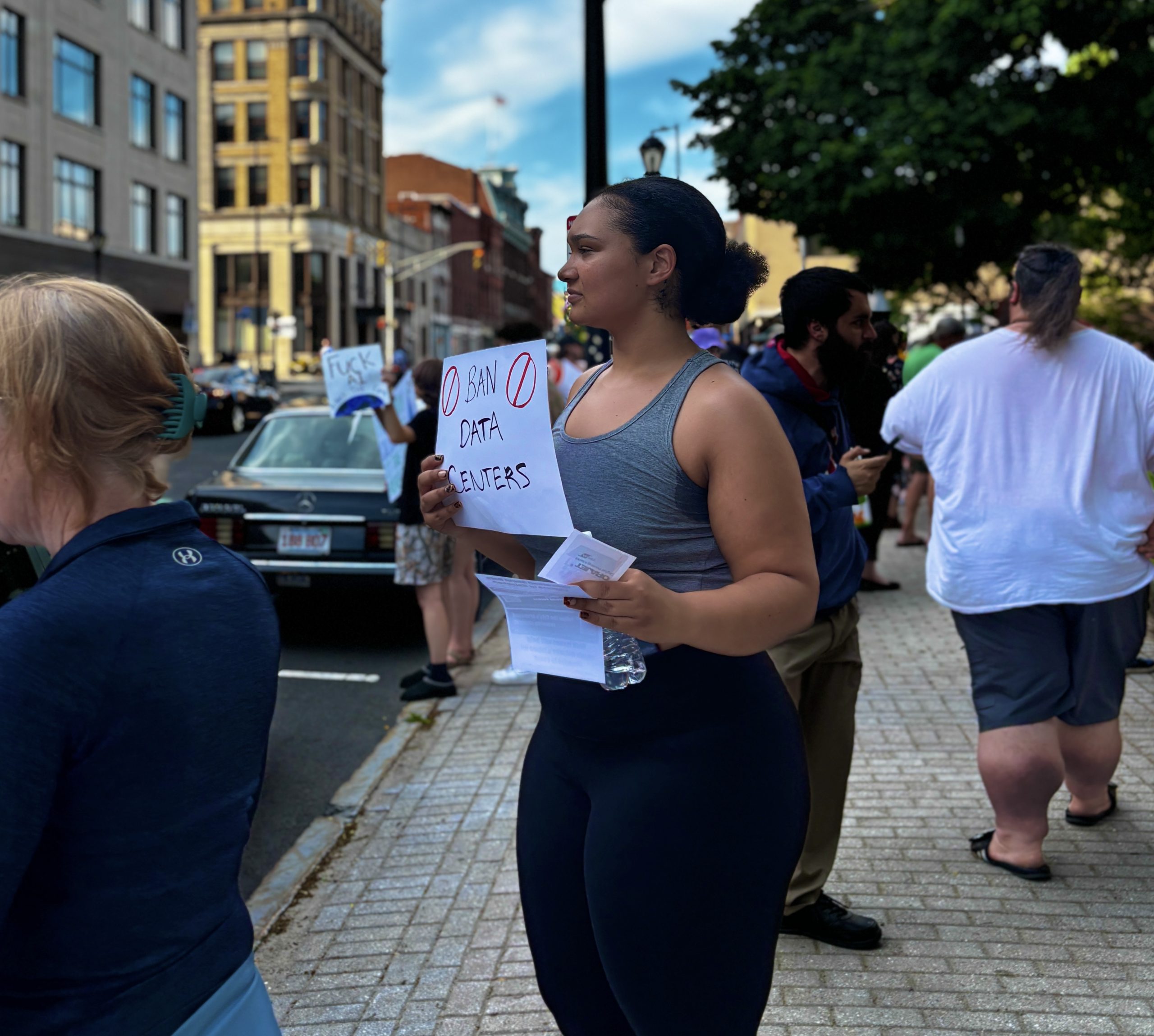
HOLYOKE — A proposed 20-megawatt data center along the Connecticut River has sparked weeks of opposition from residents. On Tuesday, those opponents packed City Council chambers and cheered as Holyoke became the first Massachusetts community to enact a citywide ban on artificial intelligence (AI) data centers.
The ban, which will prohibit any AI data center development over 12 megawatts, passed in a 9-4 vote.
City Council President Tessa Murphy-Romboletti joined councilors Howard Greaney, Michael Sullivan and Linda Vacon in voting against the measure. Voting in favor were councilors Israel Rivera, Mimi Panitch, Anne Thalheimer, Nicole Maisonet, Richard Purcell, Juan Anderson-Burgos, Meg Magrath-Smith, Jenny Rivera and Patti Devine.
The ban does not include the Massachusetts Green High Performance Computing Center on Bigelow Street. That academic research facility opened in late 2012 as a supercomputer and data storage resource for several universities, including Harvard, the Massachusetts Institute of Technology and Yale.
According to Murphy-Romboletti, the decision by the council does not need to be ratified by the state attorney general’s office. While the mayor may veto the ban, she said, “I have no idea if we’d get to that point, but if we do, the council can vote to override the veto.”
Despite the council’s vote, the developer who proposed the new data center still aims to put down roots in the Paper City, which offers vacant industrial space to redevelop and access to clean, locally controlled power.
“We’re still taking in the council’s decision and want to review it carefully before we say more,” said Ben Marshall, co-managing director with Chestnut River Power and Infrastructure. “We remain committed to finding a path for a project that works for Holyoke, and we’re grateful to everyone who engaged in this process — the council and residents alike. We’ll have more to share soon.”
Marshall added, “We believe in Holyoke — in its industrial heritage, in Holyoke Gas & Electric, and in Massachusetts as a place to build … our interest in Holyoke isn’t a passing one, and we’d welcome the chance to find an approach that works for the city and its residents. We’re not closing the door — and we hope Holyoke won’t either.”
Chestnut River had not filed permits or purchased the property at 100 Water St., the proposed location for the data center inside a vacant industrial complex in the Flats. The site most recently housed marijuana cultivation operations.
The envisioned concept involved an adaptive reuse of the former mill and would not require ground-up construction. Under the plan, the facility would be powered by Holyoke Gas & Electric under a dedicated service agreement, structured so the project would pay the full cost of the power it consumed. According to Marshall, the facility would have no impact on the energy bills of other HG&E customers.
Water pollution has been a universal concern among those opposed to the data center. To cool the facility, an estimated 250,000 gallons of water would be used daily. However, Marshall stressed that this is a preliminary estimate, not a final figure.
“Holyoke Water Works has indicated the municipal system can accommodate substantial additional capacity well beyond that,” he said.
The developer has highlighted community benefits that include $2 million annually in new property tax revenue for the city, construction work for local trades that would have worked on the $200 million project and the adaptive reuse of a vacant industrial property.
A hearty coalition against the development sprang up after the proposal became public, with dozens of people showing up at previous meetings to protest at City Hall and speak during public comment periods.
Concerns ranged from water pollution and strains on Holyoke’s electrical supply to potential noise pollution and fears that such centers could be used as part of a “fascist” tactic to harvest personal data.
“I grew up here. This is my home. I’m here today because I think that a lot of people are uninformed about the consequences of what a data center could bring to the city,” said Arianna Ketchakev, standing outside City Hall last week with others holding a sign reading, “Ban Data Centers.”
Ketchakev, a robotics engineer, said that residents do not have the same access to information as developers, who possess the resources to shape public narratives. Meanwhile, she and others said that the data center threatens not only Holyoke, but every community downstream along the Connecticut River.
“I think that they are taking advantage of lower-income and marginalized communities, especially in a city where a lot of people’s first language is not English,” she said. “I think that they are trying to advocate for this on the pillar of it’s going to bring jobs, when in reality, it’s going to destroy our water sources, it’s going to cause noise pollution, it’s going to cause air pollution, and it’s going to impact every single town south of this because of the Connecticut River.”
Holyoke resident Gloria Caballero, one of at least 100 people outside protesting in front of City Hall last week, agreed. “What they [AI data centers] create is pollution, contamination,” Caballero said. “We’re also getting together and saying no to our data theft, because it’s not only what they bring, but they are getting all our information like a supercomputer.”
Water pollution is a primary concern for 19-year-old Savannah Donnelly of Holyoke.
“I’m young and I grew up here my whole life, and I don’t want to see my city, which already gets a bad rep, become bad because of people that don’t live here or don’t have anything to do with the city of Holyoke,” she said.
The majority of councilors in favor of the ban, most notably Rivera and Thalheimer, have expressed that they would not settle for a two-year moratorium, which was on the table during last week’s Ordinance Committee meeting.
Thalheimer pointed to a sign that dominates the Council chamber that reads, “Makers of Law, Makers of History,” and called upon her peers to vote in a full ban.
“We have the ability to make history,” she said.
Ahead of Tuesday’s vote, Murphy-Romboletti posted to Facebook to clarify why she remained hesitant about a ban and what led her to ultimately vote “nay” on Tuesday.
“I have strong reservations about passing a permanent ban on any industry without a defined timeframe and a commitment to doing the work necessary to develop thoughtful regulations,” she wrote. “My position has never been that Holyoke should welcome massive data centers without restrictions. My position has always been that we should take the time to understand the issue, gather public input, and create policies that will stand the test of time.”
Councilor Sullivan received a resounding “boo” from protesters when he said during last week’s Ordinance Committee meeting that the data center would not impact Holyoke’s water supply “at all,” while Vacon argued that the council should step back and consider more information before implementing a ban.
Mayor Joshua Garcia did not respond to requests for comment following the vote, but shared his take in a June 3 Facebook Post. In it, he stated that he hears and understands residents’ concerns, but wanted to clarify that energy costs and the city’s water supply would not be impacted by a data center.
He also noted that the proposed Holyoke project is “fundamentally different” from other developments that are arousing concern throughout the country.
“At just 21 MW, this is a small, right-sized facility, comparable to the Massachusetts Green High Performance Computing Center (MGHPCC) that has operated responsibly in Holyoke since 2012 without negatively impacting our water or electric supply,” he said. “It is nothing like the massive gigawatt-scale projects proposed by billionaire developers elsewhere. To put it into perspective, there are 1,000 MW in just one gigawatt. This is a fraction of that scale.”
While Holyoke is the first city in the state to implement a ban, the town of Mansfield voted during its annual Town Meeting in May to adopt a near-total ban on large facilities. The zoning change still awaits approval from the attorney general’s office.
In March, Lowell implemented a one-year ban, making it the first community in Massachusetts to enact a data center restriction.
Read the Original Article
This article was originally published by Daily Hampshire Gazette. Click below to read the full article on their website.
Visit Daily Hampshire Gazette